

Illustration by José Reis de Matos, http://jrmdessin.blogspot.com/
I’m not much of a collector, but I do have one passion which I suppose would put me in that category: old, rustic French confit jars, the Provençal ones made of clay that are round and fat with tiny handles, and a gold or green band on the top half of the pot.
 I adore their drippy, colorful glazes, the weathered terra cotta exposed at the bottom, their plump, pleasing shape. I like that each one is different, and designed with such thoughtful beauty for a practical use. But I never completely understood how they were used. I saw confit of duck, for example, on the menus here, but never quite got the term. My French dictionary defines confit simply as “potted meat”.
One early fall day while Nicole and I were cooking in the summer kitchen together, my question was answered. We were stirring up a big stew over Nicole’s huge wood-burning stove, the luscious smell drifting out of the French doors into the sunny courtyard. It was a lazy day, perfect for musing over cooking memories from autrefois, days past. Nicole grew up in the pretty town of Pau in the southwest part of France, and her grandmother lived on a country road where there were only two other houses. She told me the story of the big festive fall event there: the killing of the pigs.
These were the days before refrigeration, so pigs were killed in November, when it was cool. One family killed a pig, and hams and sausages were prepared, cooked and stored by all three families. Then the next family would kill their pig, and the process was repeated. With this shared bit of work, each family was set for the winter.
The various cuts of meat were stored in huge confit jars, along with a cooked duck or two and perhaps a goose. They were covered with the rendered fat, which was thick, yellow, and gelatinous. This preserved the meat and also tenderized and flavored it. Any leftover small bits were stored separately, also in fat, and these are called rillettes (rillettes can be any meat or fish which is mashed up with fat to form a paté or a spread).
Every Sunday, for that luncheon which is the celebratory family meal of the week, la grand-mère would roll her sleeve up all the way and reach deep down into the thick fat of the confit jar. The first thing she pulled out would be Sunday dinner. The main course, then, was always a surprise.
Nicole loaned me a fabulous cookbook called Cochon & Fils by her friend Stéphane Reynaud, which 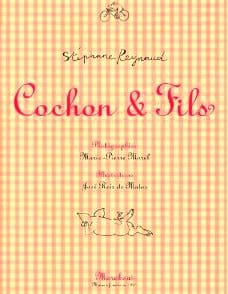 includes an exhaustive history of the tradition of killing a pig, using every morsel. I was going to offer his recipe for confit de cochon, but I feared for your lives. It has basically 3 ingredients: pork chops (not lean ones), an enormous slab of bacon, and a great quantity of duck fat. A meat-lover’s dream to be sure, but I chose instead to go with a luscious one-dish saucisse recipe with lots of vegetables, though it’s not really lowfat. The French aren’t at all afraid to cook with copious quantities of fat, but then they’re skinny and live the longest, so there you go. Some Sunday, then, if you should roll up your sleeves, dip into your freezer, and come up with sausages, this is just the ticket.
RECIPE: Gratin de Saucisses de Montbéliard, Tian de Legumes au Thym ( Smoked Sausage Gratin on a Tian of Vegetables, with Thyme), from Cochon & Fils
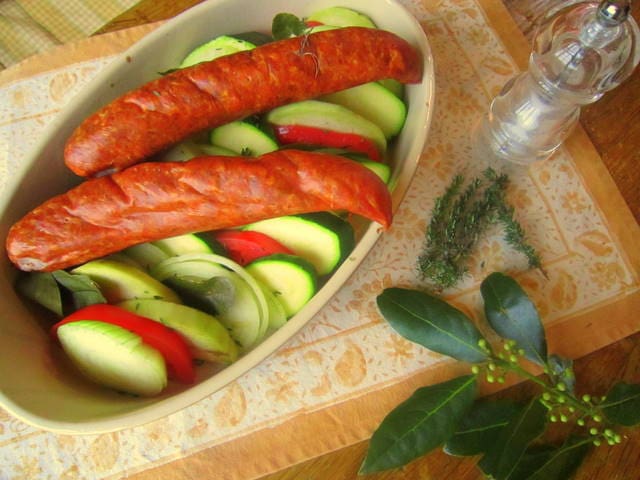
Photo: Ready for the oven, Msr. Reynaud's French comfort food
Serves 6
- 6 Saucisses de Montbéliard (use any smoked sausage, like kielbasa, 2 lb or 1 kg)
- 2 small eggplants
- 6 tomatoes
- 4 zucchini
- 3 large onions
- 6 sprigs of fresh thyme
- 4 bay leaves
- 6 cloves of garlic, coarsely chopped
- 2 tablespoons (25 grams) of butter, melted
- 1/3 cup. (100ml) of good olive oil
- 2/3 cup (200ml) of white wine
- Sea salt
Cut all vegetables into thin rounds. In a baking dish, arrange them in alternating rows, standing them up vertically. Add the butter. Remove the thyme leaves and add, tuck in the bay leaves and sprinkle with the garlic. Add the wine and olive oil. Prick the sausages all over so that their fat will flavor the vegetables, and put them on top. Cover the dish and bake for one hour at 325 degrees (160 C). Season after cooking with sea salt.
(My note: Do not salt before cooking. I uncovered this toward the end and turned up the heat a bit. It will be juicy; dish it out with a slotted spoon, or serve in a shallow bowl with the juices. Serve it with Dijon mustard if you like, or pass the grated Parmigiano-reggiano and ground pepper).
In the Comments this week: Jon-Henri, Natalie, and Monty have café stories of their own to tell. Maureen correctly points out that it’s ‘espresso’ in English (and Italian); I used the French spelling, expresso. Johnny bemoans the ubiquitous disposable coffee cup in the US, me too. And even Mickey, my mom who hates to cook, gets frisky with the recipe. Kristin, our Nespresso machine has been on vacation too! In the previous week’s post, the comments continue: Suzanne’s bread question clarified, and Mark and Nicole chat about Morocco.
I hope you’ll check out my article in the October issue of France Magazine on the village of La Turbie, on the Côte d’Azur.
Unless otherwise attributed, all POSTS, PHOTOS and RECIPES on this blog copyright ©2010 Lynn McBride. All Rights Reserved.

















6 thoughts on “A Chatelaine’s Tale of Pigs and Pottery”
Great! Such an intimate glimpse of French ways from another time. In my guest blog about tagine, I mentioned a similar Moroccan practice from the old days, preserving strips of cooked lamb in big crocks filled with butter. Same purpose–having meat at hand all winter. Big difference; the butter went “rancid” or “cheesy” (take your pick) and the flavor is an acquired taste.
….sounds absolutely delish! Will pass it on to my husband who adores all kinds of sausages (we live in Germany) and does the cooking here for us. Thanks for a wonderful blog. It always seems suffused with sunshine and joy! blessings, Maureen
When I was a kid I grew up in a small Cotswold village in the UK where most ordinary families kept a pig. It was bought from a local farmer in spring, fed on food scraps and killed in early December. The pig was always referred to as ‘the gentleman who paid the rent’ since it was the main source of meat in the winter. Most was salted for ham and bacon, the rest was made into sausages or shared with neighbours. A special treat was pigs trotters and pickles in front of the fire.
Mes belle-parents did the same thing. (Grand-mere and grand-pere were farmers). I remember them speaking (with less than affection) of the results if a (male)
pig was incorrectly cleaned after butchering: loooong
months of stinky meat which no amount of ‘doctoring up’ could take away! They would additonally use some of the rendered fat for other things,such as frying potatoes,etc– also for a quick breakfast or snack, spreading some on a slice of bread,topped with a sprinkle of hot paprika.
Don’t honestly know if I could now relish this,but back then, on a cold day,it tasted really good.
Lynn, I bought the ingredients today for your fantastic sounding recipe, and intend to make it
tomorrow! YUM!
THANK YOU for both it and another wonderful post.
You brought us into the kitchen with you and Nicole, your descriptions making us inhale those heavenly aromas(!).
Looking forward to reading your article!
Bon journee!
mmm I always crave rillette, I’m definitely missing living with my French friends now…
I NEED a couple of those pots for a painting!!!