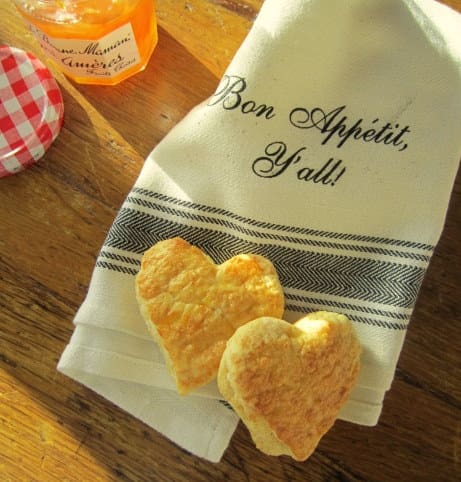
OK y’all, you knew sooner or later the topic would come up: Biscuits. The pinnacle of southern cooking.
Now in France, they don’t know from biscuits. And yet…look at the spelling, it’s a French word! This particular parole originated in medieval France, (about the time our favorite château was built, actually), from the latin bescuit, or ‘twice baked’. Along the way, the second baking got thrown out, except for the Italian biscotti. The French pronounce it bis KWI and it means a cracker or a thin, crunchy cookie. The Brits use the word the same way as the French. Those pesky American colonists kept the name but changed the recipe and the pronunciation, leading to the current confusion.
A side note: if you describe a southern biscuit to the English, they will say, “oh, you mean a scone”. Non. A biscuit in is not the same as its drier, firmer English cousin, which nevertheless is an acceptable vehicle for lots of clotted cream and jam.
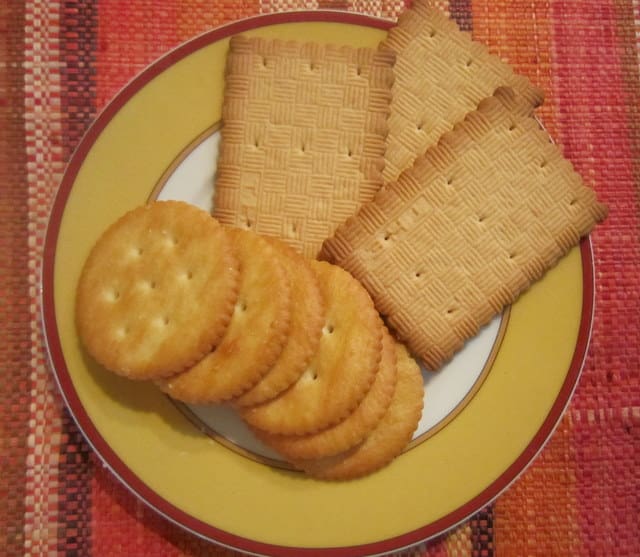 No, light and fluffy Southern biscuits, or the flat, crunchier old-fashioned version called beaten biscuits, are not found anywhere in Europe, as far as I can tell. Happily, the ingredients are readily available (except for buttermilk, which I haven't found yet). They are dead easy to whip up. Photo: The French & the English think these are biscuits.
I will share with you my very favorite southern biscuit recipe, gleaned from years of testing. I like this version because it makes lovely biscuits without buttermilk, though by all means use it if you have it. The only French touch I've given these is that instead of buttermilk I use a mixture of milk and crème fraiche, which makes a mighty fine biscuit too. I like to use a heart shaped cutter, it makes them more fun.
For the uninitiated, biscuits, traditionally eaten for breakfast but good anytime, are meant to be eaten with lots of butter, never dry. When I serve them to the French, I always butter them while they’re hot before I serve them, because they do not generally butter their bread and will miss the fun. Jam works, too; honey and molasses are also common toppers for a split, hot biscuit in the South. For me the best thing to put on a biscuit is orange marmalade, but I must admit my neighbor Marion’s white peach jam from the garden is pretty wonderful with them as well.
Ron, who lived in Charleston many years but is from ‘off’, is nevertheless an enthusiastic biscuit convert. He has tried to train me to get up with the chickens every morning and make a batch so that the aroma of baking biscuits wakes him up. To this I say, Fat Chance. But I do indulge him from time to time.
RECIPE: Lynn’s Southern Biscuits from the Heart, slightly Frenchified
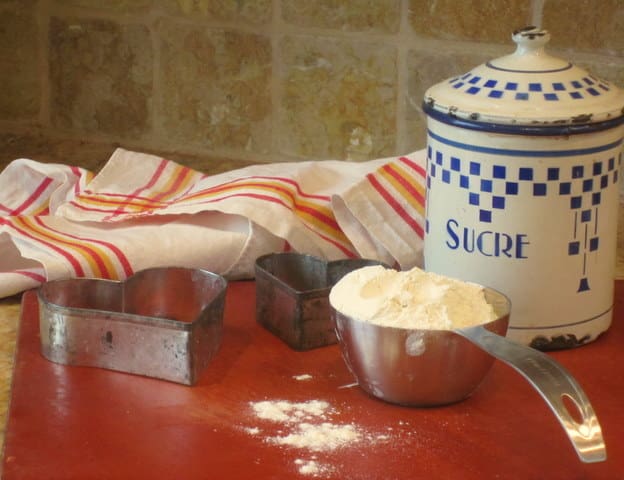
2 tips: you can mix in the butter with your fingers the old fashioned way, but for truly great biscuits, I must admit that a food processor is the way to go. And if you avoid making them due to the messy clean-up, try this neat trick: sprinkle a little water on your countertop, then cover with a large piece of plastic wrap. Flour it and turn your dough out onto it to work it. When you’re done, just fold it up and pitch it. Voila, a clean counter.
Oven: 400 degrees F, (200 C)
- 2 c. flour
- 1 tablespoon baking powder
- 1 teaspoon salt
- 2 teaspoons sugar
- (If using buttermilk or sour milk, add ½ teaspoon baking soda to dry ingredients)
- 1 stick (113 grams) cold unsalted butter, diced
- ¾ cup liquid: stir together about half milk & half crème fraiche (or sour cream), or use buttermilk
- Egg wash (1 egg beaten with 1 T milk)
Put dry ingredients in food processor, pulse to blend. Add butter, and give it about 10 one-second pulses until mixture is like a coarse meal. (or, knead butter in with your fingertips). Turn out into a bowl.
Make a well and add liquid all at once. Stir quickly with fork, just until dough comes together in clumps, there may be a bit of flour left that you can mix in as you knead the dough. Turn onto lightly floured surface. With floured hands, knead and fold dough just a couple of times until it comes together nicely into a ball, then pat out into a circle about ½ inch thick. Use heart-shaped or round cutter to make about a dozen biscuits (try Kaiser Bakeware Heart Cookie Cutter, Set of 6). Place on cookie sheet, on a Silpat Non-Stick Mat
Making biscuits ahead: cooked biscuits can be wrapped in foil, frozen, then thawed and re-heated in a hot oven. I prefer to freeze them before cooking: after cutting them out place them on a small cookie sheet or pie plate, close together, and cover the dish with plastic wrap or foil. When they’re frozen into little rocks, you can remove them and put them in a freezer bag. Thaw and bake as in recipe. This way you won’t have to get up early to please your Sweetie!
If you missed last week's post, you can read it this week at Your Garden Show, where Southern Fried French is a guest blogger!









32 thoughts on “‘Les Biscuits’, Gone South”
Bravo!
For me part of the pleasure of eating biscuits is the moment when a morsel turns to paste in the mouth and cleaves to the palate–some sort of alchemy of flavor happens.
I thought I invented that trick with plastic wrap. I use it to roll out pie crust. I probably just forgot that I’d read it somewhere.
“The French pronounce it bis KYI and it means a cracker or a thin, crunchy cookie.”
I’ve always understood the correct French pronunciation to be bis KWI, from the verb cuire. Is the French pronunciation that you have quoted perhaps a regional one? As you know, the further south you go in France the more the standard pronunciation changes.
Hi Nick,
It is bis KWI, which is a typo on my part, now corrected, thanks very much.
Why not substitute plain yogurt for buttermilk?
Sounds delicious Lynn ! Here in Maryland we had a heavy dusting of snow .
It is bitter cold. Butter on biscuits causes my N.C. southern memories to awaken my taste buds. I will prepare them for dinner tonight.
Thanks for the suggestion…heart biscuit cutter.
Sarah
YMMMM, we can vouch for Lynn’s biscuits! They are fabulous – with just about any meal…even our last Thaksgiving! Forget the french bread when Lynn makes biscuits. Have fun with the recipe – smiles, Ali
….I’ll just never understand these biscuit differences. In Germany where I live “biscuit” is a sponge-type cake (as we call them in Australia!). Dieu only knows what you lot call THAT in the US….Ours are tall, towering affairs, layer after layer, spliced together with cream or jam and majestically coated on top with whipped cream and slatherings of choc chips or fruit or whatever the imagination devises for the event. In Germany the “biscuit” cake is quite thin and typically covered with sliced fruit of the season, splattered over with a liquid gelatine layer – and is NOT very delicious. They also call this a “fruit cake” – which (here we go again) is miles away from what Anglo-Saxons adore as a fruit cake, to wit that heavy (with kilos of dried fruits), moist (with sloppings of brandy and indecent amounts of butter), dark (with allspice and sneeze-inducing medicinal-tasting spices) tall cake that keeps literally for years. It is inflicted upon all celebrations from births to weddings and funerals as well as Christmas. A weight-watcher’s nightmare, an icon in Oz as well-known as Vegemite and Gravox, it may well be on the way out with the younger generation as it takes hours to bake at a low heat and makes a huge hole in your household budget.
PS just wanted to say that buttermilk is very easily available in Germany and you’re NOT that far away. Called Buttermilch it’s a popular drink and every supermarket has it. I could send you some….this time of year there’s no fear of it curdling, LOL.
Hi John,
Well why not use yogurt? Never thought of it, but it’s worth a try.
Oh, Lynn, I just love this blog! It just gets better and better, which is not easy. Having eaten your delicious biscuits prepared as a base for strawbery shortcake on my birthday I am surprised you didn’t mention that way to eat them also. Any way is fabulous and I am very inspired to try my hand at a little heart shaped shortcake now that I have the exact recipe!
Also adored the storys of Margaret.
Thanks for the memories.
Ellen
I’ll try to enclose a photo of the birthday shortcake
I will try them when I’m next in Provence. The stove I use there has numbers. What number would 200C be?
Elizabeth
Hi Lynn,
It was such a coincidence that I happened to be eating biscuits with 4 berry preserves when I opened to read your blog on this lovely Saturday morning in Miami. I have a recipe named “Angel Biscuits” and a package of yeast goes into it. They’re fancy biscuits and definitely not cooked in our household everyday. I had a list of “substitutions” and I remember that you could put a small amount of vinegar into milk to produce a reasonable buttermilk facsimile. But, I can’t find the list for exact amounts. I also love your blog!
Salut Lynn,
200 degrees C converts to 392 degrees F.
Here’s a handy link for converting temperatures:
http://calculator-converter.com/converter_c_to_f_celsius_to_fahrenheit_calculator.php
À bientôt
Salut Lynn,
Oops! My previous post didn’t answer the question of how 200 degrees C converted to the 1 to 10 marking on some stoves. In a further search of the internet, I found this link on which the “Gas Mark” measuring system is converted to the Fahrenheit and Centigrade systems. Hope this helps.
http://www.cookingforengineers.com/article/134/Oven-Temperatures
À bientôt
Lynn, I’m going to try your biscuit recipe soon, with a Christmas cookie cutter. My KY grandmother made the best biscuits I’ve ever had! She made them with buttermilk and LARD! She did them kind of like sour dough bread, saving a bit from each batch as a starter for the next. She cut hers with a small cutter. Next best were my Dad’s biscuits; he used lard or butter flavored Crisco, and cut his larger. I think when made well, southern biscuits are as good as and have a similar taste to French bread.
Hi Lynn
love your blog it makes me feel very home sick for France,I will try your Southern biscuits for Christmas .The weather in Australlia is very hot and I have just baked my christmas cake full of dry fruit soaked in brandy for 1 week.I will send you the recipe
Love
Mariella
Hi Elizabeth,
As Herm says, the temperature is 200c or 400F. If your stove has numbers on it from 1 to 10, as many French stoves do, the number you want is 7.
What about using Kefir? It is a fermented milk, and I think you will find it in France. I use it in place of buttermilk here in Italy…I make buttermilk biscuits when I forget to buy bread, a capital sin in my household.
That’s real funny how similar words are used and changed between english and french langages and I guess it is the same between other langages as well.
Biscuit is a good example of what happen to a word whenever it crosses the borders.
One other good example is the word cake. For us French, cake (pronounced identically to the english word) is something different and let explain how I bake
a “cake aux abricots”
What you need:
– A bag of dried apricots (250g)
– rum
– 3 eggs
– yeast
– sugar
– flour
– margarine
First thing you do, put your dried apricots in a bowl with lukewarm water and add 1 or 2 spoons of rum (white or amber), let it rest for 2 or 3 hours
Stir with fork three eggs with 70g white sugar, add 160g flour with 1/3 of a baking powder bag
Let melt 125g margarine (unsalted butter will perfectly work) and add it to your preparation
In the meantime, remove the apricots from the bowl, dry them and cut them in small parts, flour them and add them to your preparation
Use a buttered and floured “moule à cake”
It’s take 40 minutes in a preheated stove at 180°C to have a cake the french way
Easy done and just taste great
I have another good suggestion for biscuits WITHOUT buttermilk. Use heavy cream. Two variations that I know of: use 1 cup cream to 2 cups flour, plus 1/4 cup butter. OR make a small batch with 1 cup flour and 1 cup cream, no other shortening needed. These are called CREAM BISCUITS, and although they don’t have the sour taste, they have great texture, and are delicious.
Salut Claude,
The ingredients list calls for yeast, but in the directions baking powder is added. Which is correct?
À bientôt
hum! is yeast and baking powder not the same thing? Anyway here in France, I use “sachet de levure” that is to say pack of yeast (11gr)
Hope that answer your question
Bon appétit
Merci Claude,
In the United States, yeast and baking powder are different. To make things more confusing, there’s also baking soda. I’m no expert, but I sometimes see baking powder used with baking soda in quick bread recipes. Lynn’s the expert, maybe she’ll set us straight.
À bientôt
OK Herm and Claude, here’s what I know! Yeast and baking powder are both used to make things rise, but used in different ways. Yeast (levure) is a living organism and it takes time to rise, usually used in bread. It gives a yeasty flavor, too. Baking powder (levure chimique) is a tasteless chemical and is used in cakes and quick breads. It requires no rising time. A bit of baking soda (bicarbonate de sodium) is added as well when the liquid used is acidic, like vinegar, buttermilk, sour cream.
Thanks a lot, Lynn, my cooking knowledge improves as quick as my skills in the English language
It’s Christmas Day. I just found a great sounding recipe for Sour Cream Biscuits. I’m going to add it to your collection.
just read your blog. we were in Lille with daughter & in-laws most of dec.
here is another way to freeze biscuits. prebake for about 7 min. or until set. cool & freeze. when ready to use remove frozen biscuits and bake for alloted time. really enjoy your blog as i love to cook
sue in cashiers,nc
Just want to comment on the idea of putting yogurt in biscuits. I think it would work, might affect the texture, but I’ve used it in pancakes and cornbread when I was short of buttermilk, and it worked.
Thank you for posting this recipe – i made these delicious “scones” (as we call them in South Africa) today with creme fraiche.
They were light & delicate especially warm with butter & smooth apricot jam – SUPERB!!! recipe 🙂
I thought i would report back again!!
I just made these again because we loved them so much. This time i invited my elderly neighbours for tea – we all agreed they were deliciious and 4 of us ate the whole batch (thank goodness or my Husband & i would have!!!)
The debate with your friend …… we all agreed they are more “bisciuty” than scones which are more “doughy”.
They are crispy outside & delicate inside 🙂
Thank you again – my favourite go to recipe at the moment!!
I still have not tried your biscuits, but I plan to soon. My Christmas gift to myself is going to be to do some baking, which I normally don’t do any more, because I overeat. I do think that I will omit the sugar. I’ve never heard of sugar in biscuits, unless they are going to be used for shortcake.
This is a super late post, but I just stumbled on to your site trying to differentiate something similar to a gateau Breton which tasted closer to a scone. My wife and I work abroad in France during the summer months while running our Charleston based music agency. I’m Franco/American and was raised in SC by the way. Well, the mention of fried chicken and Charleston on your site certainly caught my eye! I’m chiming in to add, in case you haven’t located buttermilk in the past 15 years since this was originally posted, that lait ribot is found usually by any vendor selling butter. I got some by accident last week, and enjoyed it all the same. We’re in Rennes – Bretagne where butter is king (Normandy too), but I bet you can find some in Bourgogne pretty easily. I too noticed that southern style biscuits don’t exist here – None of my family has heard of them. That prompted me to ask a family friend who’s known for her biscuits for the recipe. I look forward to sharing them at some point soon, and now I know how/where to find the buttermilk!
-Looking forward to further exploring your site. 🙂
Andrew & Arlene