

When my husband and I decided to retire to France, in spite of our rudimentary French language skills, our globetrotting friend Harry had four words of advice for us. “Stay away from ex-pats”, he cautioned darkly. “They will all speak English,” he warned, “and you’ll never learn French if you hang around them.”
Americans are not known for their superior foreign language abilities, and we were no exception. We thought total immersion would be a fine choice for language learning. Early on in our French adventure we met an English couple who had made a firm vow that for their first two years in France, no English was allowed in their home. They read only in French, watched French TV, and avoided the ex-pat community entirely. Their French was admirable. We hated them.
Despite our envy, we soon found that we didn’t really aspire to this kind of discipline. If there is one rule about the maddening, uneven, and immensely gratifying process of learning a second language, it is that there are many paths to proficiency. Total immersion was far too exhausting for my husband and me, but we quickly settled on sustainable compromises. We attended an immersion program in the south of France just before settling in Burgundy. After the move I threw myself into private lessons, plus a weekly conversation group with other ex-pats, guided by a native speaker. My husband holed up in his study on quiet afternoons with his weapon of choice, a computer-based learning program.
With great trepidation we began to invite new French friends over. At first we viewed these all-French evenings with a mixture of exhilaration and a sense of dread. They were at once enlightening and enjoyable, fatiguing and confusing. We marvel at the patience of the French who dared spend an evening with us that first year.
On the other hand, we also cultivate friends from the rest of Europe, our friend Harry’s advice notwithstanding. Though we live in a rural village, the countryside is overflowing with ex-pats who have decamped from all over Europe and beyond. We find they enrich our experience in so many ways. When it comes to reading, I’m sorry to report we mostly choose English, but since we are tax-paying resident homeowners, the French bureaucracy graciously provides us with challenging reading material fairly often.
We may never rise to the fluent category, but our efforts have paid off. I still smile when I hear what is now a common exclamation from the French I meet: “Oh, you speak French–and you’re an American!”
 For our recipe today, I thought it would be fitting to include a truly French one (If you want a French language challenge, try reading une recette from a French cookbook!). My good friend Marie-Christine gave me a fabulous cookbook from that superstar French chef, Paul Bocuse. Fortunately his book, Bocuse in Your Kitchen: Simple French Recipes for the Home Chef
RECIPE: Salade de lentilles (Warm Lentil Salad) Paul Bocuse
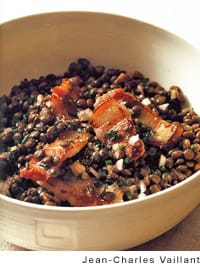 1 1/2 cups (10 1/2 ounces) lentils, preferably dark green or tan
8 cups water
Salt
1 onion, peeled
5 1/4 ounces salt pork or slab bacon
1 teaspoon Dijon mustard
1 tablespoon red wine vinegar
3 tablespoons walnut oil
Salt and pepper
3 tablespoons finely chopped chives
1 shallot, finely chopped
Directions
1. Place the lentils in a large saucepan with the water. Salt lightly, add the onion, and bring to a boil.
2. Lower the heat, cover the pan, and simmer for 1 1/2 hours, or until the lentils are tender but not falling apart.
3. Fifteen minutes before serving, cut the salt pork or bacon into 1/2-inch cubes. Fry until the pieces have browned on all sides, then pour off the fat, remove from the heat, and cover the pan to keep warm.
4. Make a dressing by whisking together the mustard, vinegar, oil, salt, and pepper.
5. Once the lentils are done, remove the onion and drain the lentils in a sieve or colander. Place them in a large salad bowl with the chives, shallots, and dressing.
6. Toss gently to season, and place the pieces of bacon on top. Serve warm.
(My note: When I make this, I throw in some cooked carrots, and I add one tablespoon of lemon juice at the end. I double the mustard and throw in a bit of chopped garlic when I cook the bacon. Sorry, Paul).
This week at Your Garden Show, my post on chickens of two weeks ago is featured as a guest blog. Be sure to visit this fun site if you haven't already, and connect with gardeners from around the world. You can post photos of your own garden, too!
In the COMMENTS last week: everyone’s got biscuit ideas, bring 'em on! Herm and Claude are sorting out yeasts; Maureen, John, and Patricia have buttermilk alternatives. Debbie’s dreaming of Angel Biscuits, and Ellen of summer shortcakes. Suzanne shares ideas about Cream Biscuits, and the old way of making them with lard. And we’ve moved on to fruitcakes, with a great recipe from Claude, Maureen on the German version, and coming soon, Mariella’s Australian one. Happy baking!











7 thoughts on “The Long and Winding Road to French Fluency”
That recipe looks like it might belong in my comfort food category! YUM-UM! As for learning French, I am gratefully married to a Canadian and he has gotten us through the French countryside when we’ve been. My three children all have learned French from kindergarten and can get by. But I can say bonjour very well!
Improving on a recette from Paul Bocuse? Bravo!
About learning another language. I highly recommend day-long immersion classes when you are twenty years old. If you happen to be older I still recommend immersion classes, especially those that feature lots of drills on verb tenses and noun-adjective concordance.
But the key element is abandoning self-consciousness, not so easy for those of us set in our ways. Another way to put it is being willing to make a fool of yourself (or even better, able to enjoy it).
The high moment of my progress in French while living in Morocco was showing up at a French cultural center to enroll in a free language class and being counseled that I didn’t need the class.
The opposite point was a chance meeting with one of the Moroccans who taught me French during the Peace Corps training in the U.S. I had been living in Fes for two years and was in Rabat walking down the main street when she hailed me. We stood together on the sidewalk and talked about this and that until she diplomatically covered her mouth with one hand (she was smiling uncontrollably) and then couldn’t restrain herself from saying “Votre accent est affreux!” (Your accent is terrible.) I deflated of course, but I also woke up and realized she was oh so right. I still had an American mouth.
When you first try speaking with a French mouth you feel like a fraud and a clown. This is the self-consciousness problem. It helps if you accept that you are acting, acting French. Mais oui.
Again, a winning recipe… it will be on our menu for New Year’s… As usual perfect timing…
In Italy lentils are a “New Year’s Good Luck”(prosperity) addition to the Holiday meal! Thank you and HAPPY HOLIDAYS
I just tried last week’s biscuit recipe and it was really good. I love the trick of keeping the counter surface clean. Up to now I only made “truckstop biscuits”, a variety I learned about working night duty at my local hospital. (Night duty people are preoccupied with food). Melt 1 stick of butter in a 400 degree oven. Mix 3 cups of Pioneer or Bisquick mix, and 1 Tbsp of sugar with 1 cup of buttermilk. Stir and drop iby tablespoonfuls nto the melted butter. Bake for about 20 minutes. Don’t know if there any substitutes for Bisquick in France.
amdla
As tourists to France my wife and I target our french speaking to what we call restaurant French. This approach allows us to attempt to eat or buy items at the marche.
Reading a French menu is yet another challenge. We have a fond memory of a kind bistro owner explaining the French pronunciation of dessert and desert when we ordered our dessert.
I recently researched Italian New Year’s food and found that they always have lentils for good luck, as we Southerners have black-eyed peas. I found a great sounding recipe with lentils, italian sausage, bacon, carrots, tomatoes, onions. It’s a stew served with mashed potatoes. I gave it to a friend who is having a NYE party, and he will make it. Now I have a French version of lentils, too. MERCI.
Merci beaucoup for your great blog and fun recommendations, recipes and stories! I am looking at attending an immersion course in possibly Antibes or in Villefranche. We have friends in Orleans, however to date have found I think, a school in Antibes that is very flexible, runs all year and affordable. Ideas and recommendations most welcome however.
Did you choose one of these locations yourself?
Happy holidays to you and your readers.
I am very much hoping to return to France by February or early Spring. We are also looking for a small home and have close friends in the Loire. We enjoy all the regions of France, so beautiful. Seems we may have decided on a small village or town home in the South West or South for climate (especially in the Winter months) reasons. A very difficult, but exciting and fun adventure and dream of ours. I am also researching a couple of different business ideas to allow us to spend more time in France and Italy and Croatia where we married.
Sending you my warmest wishes and again heartfelt thanks.
Cheers. Sandra