When I grew up, the closest I got to a cheese course was grabbing one of those orange squares, individually wrapped in plastic, and putting it on some Wonder Bread with a slice of bologna. I hope the US gastronomic reputation will not forever be tarnished by the name of this delicacy: 'American Cheese'. So when I came to France, it’s no wonder I was intimidated by folks who can keep up with several hundred artisanal cheeses and discuss them at length.
As you regular readers know, I figured out a system for putting together a sensational plateau de fromage, an assortment of cheeses for the cheese course (see the 5/28/10 guest blog at http://thedailybasics.com). But my education did not end there. Learning about cheese, like learning about wine and the French language, is a lifetime endeavor.
 At dinner with friends this week, cheese took over as the main topic of conversation. Bennett, a Californian in the midst of a French immersion program, had just learned the origin of cheese in class that day. It all probably started when sheep were first domesticated, perhaps as early as 8000 BC. Shepards used skins, often the stomachs of animals, as vessels to carry milk. Early astute cooks noticed that something interesting happened when the stomach enzymes began to ferment the milk, especially after it was ‘churned‘ by the galloping of the horses when it was transported. Photo, Sheep at Château de Balleure: where it all began.
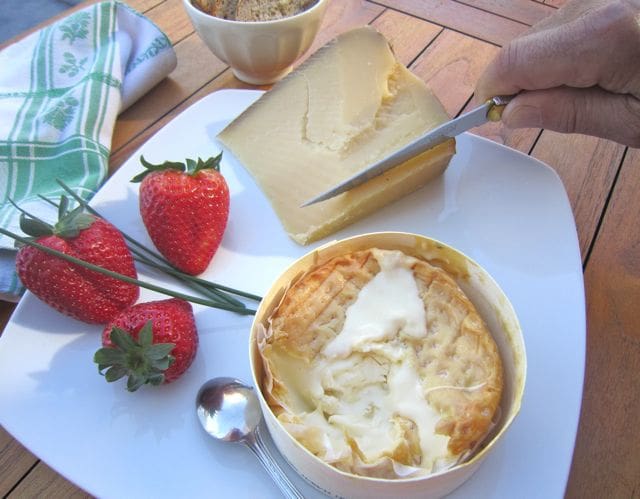
Over a plateau de fromage, our French guests began to educate Bennett on the proper way to serve oneself when the cheese is offered. You will be given a small plate and a knife. If the cheese is round, you cut a pie-shaped wedge with the knife on the platter. If the cheese is very soft, like the famed ‘aromatic’ Epoisse pictured above, you scoop out a spoonful onto your plate. But what about that big wedge of Bleu de St. Agur or Compté, lying on its side? A common mistake is to take a slice from the thinnest, center part of the wedge. Very mal élevé (badly brought up). Pourquoi, you say? The quality of cheese often varies within the round. The center may be the prime part, or the edge may the best, depending on the type of cheese. In any case, cutting a slice off from thick edge to narrow center assures that every person gets their share of the the best bits (as in above photo).
Then, you tear off a piece of your bread, and use your knife to cut and place a bite-sized morceau of cheese on top. With this you sip your red wine, always served with the cheese course with the exception of fondue, which goes better with white wine.
Our guests Jean-Marie and Marion also told Bennett about the buying and storing of cheese. Cheeses that ripe are rarely ready to eat when you purchase them. You store them, wrapped, in the fridge and sniff them daily until they smell just right. A Brie or a Camembert (which Jean-Marie says is the best French cheese) will have a soft center, and the color of the rind will darken slightly. If it smells of ammonia, you have waited too long. Marion advised that the cheeses that are marked down and past their expiration date are the best to buy, because they are generally ripe and ready to eat.
Please don’t commit that mortal sin of serving your cheese cold, they cautioned. Take it out of the fridge 3 or 4 hours before you serve it. Photo of cheeses at Les Halles in Lyon by Patricia Glee.
Marion then shared with us a most clever little recipe for dealing with the leftovers from a plateau de fromage. If you live in France, (or if you’re a cheese-o-phile), you will invariably end up with dribs and drabs of this and that leftover cheese, their packages becoming ever smaller as the week goes on. They seem to multiply in the frige, especially after a dinner party. Now I know what to do with them. This sounds so delicous you may be tempted to go out and buy a fresh assortment just to try it.
RECiPE: Hot Baked Cheese Mélange à la Marion
Take several bits of any sort of leftover soft cheese (it’s best if you have a little blue cheese for the mix) and put them all in an ovenproof ramekin. Trim off any rinds that are thick or have seen their better days.
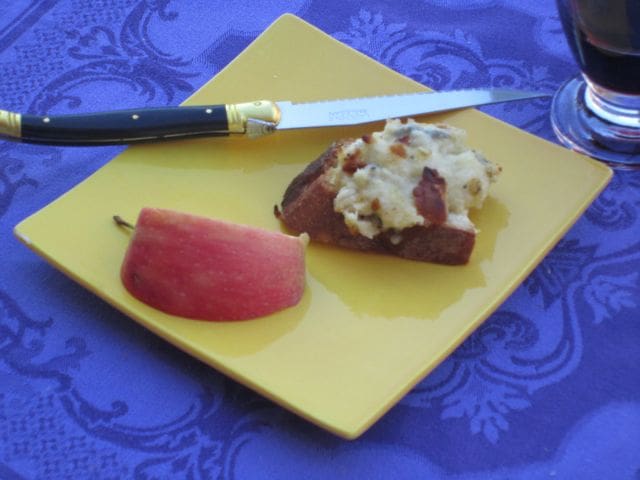 Microwave the cheese just until it’s melted, less than a minute. Stir in a garlic clove, pressed, and some black pepper. Add a splash of cognac, or white wine, plus a sprinkling of herbes de Provence if you like. You can keep it in the ramekin at this point, or put it into a shallow, oven proof dish.
Top the cheese with bread crumbs (hopefully you have some in the freezer, made from your leftover baguettes). Run it under the broiler briefly until the crumbs are golden brown. Put it in the center of the table, crack open a bottle of red, give everyone some bread for scooping, and watch it disappear.
Favorite Reads: For a good overview of French cheeses and a quick reference, I've used French Cheeses by Kazuko Masui for years. If you really want to be a pro, check out Mastering Cheese: Lessons for Connoisseurship from a Maitre Fomager. It's an exhaustive study of cheese and a fun read besides. The cover photos alone will have you drooling.
In the Comments this week: A Latin lesson this week from Mark Kane of www.yourgardenshow.com. Sic transit gloria mundi, "thus passes the glory of the world", he says in discussing his travel memories of a glam Moroccan resort. Patricia is dreaming of fresh artichokes and seafood on the Italian riviera, and Mark and Harriet know Cap Ferrat. Meanwhile Jacqui, back on French living destinations, chooses Bonnieux. Bon voyage, or at least beaux rêves, to all!
Unless otherwise attributed, all POSTS, PHOTOS and RECIPES on this blog copyright ©2010 Lynn McBride. All Rights Reserved.













13 thoughts on “A ‘French Cheese Virgin’ Gets an Education”
My husband and I would love to live in Paris, Marseille, or wherever we could afford (I realize Paris is off the charts expense-wise but we love it after Santa Fe the buzz is nice)… we are leaving on the 30th for a two month stay and as you say, always end up with bits of cheeses… will look forward to trying your method of “good riddance”… I remember one of our first trips to Paris how I watched with total awe and fascination a man in the cheese section of what is now Carrefours in the 6th, picking up every cheese and smelling it thru the wrapping… I realized there was a lot I needed to learn about the “art of cheese”! But it’s great fun learning….
Oh delicious! Nothing so lovely as a nice cheese course after a lovely light meal on the terrace on a warm evening…sadly my visions will be dashed as we are expecting snow this weekend! I shall close my eyes and imagine instead.
After having a tangy spread called Bruss or Bruss in the Piemonte region of Alba, I looked for a similar recipe when I returned home. Bruss is usually made from leftover toma or robiola cheeses and is fermented in a crock. Supposedly there is a saying that goes “Only love is stronger than Bruss.”
Fromage Fort is a French variation for dealing with cheesy leftover bits — quite similar to what you describe but does not involve the microwave. Simply cube the leftover bits, put into a food processor, add a clove of garlic or two to taste, a good splash of white or red wine, and some pepper. You could add some herbs if you wished – fresh rosemary and thyme are my favorites. Process until smooth and creamy. Can be served as is (room temp not cold) or spread it on crusty bread and then run under the broiler. Fantastic as an accompaniment to homemade tomato soup. I have used all types of cheese for this – Muenster, epoisse, feta, gruyere, taleggio, cheddar, goat, blue, gouda, romano. It comes out slightly different each time depending on what you throw into the mix.
When I don’t have leftover cheese, I scan the “leftover bits” bin at Whole Foods. They usually have small hunks and tail ends of cheeses in a basket, each piece being less than $2.
Dear Lynn ..Cheeses left in my refrigerator after a visit from a daughter were more like hunks and globs rather than dribs and drabs…But I made your hot cheese melange and it was wonderful.
smelly cheese pasta is another way to use up those bits. no particular recipe, just use your imagination. for example, a generous bit of pont leveque gently melted in enough creme fraiche to make a semi-liquid that clings when tossed with your pasta is really yummy. anything goes!
Sadly, another mistake Americans have been know to make it to cut off the “nose” of a wedge of Brie, leaving a blunt end!
Thanks for your lovely recipe, I shall try it soon.
Meanwhile, what do you advise for keeping your cheeses fresh in the fridge after opening? I try to wrap in wax paper, but sometimes the various strong odors get mixed in with mild cheeses.
Love your blog, thanks! Merci!
Merci for the ideas about what to do with the leftovers. My husband rarely leaves a pinch even, but I might start grabbing some of the chunks as they get small and make your recipe. I would love to spread that on some crostinis. I see the epoisse and can’t wait until I hit Dijon this summer.
as always…new things to learn! And this time about my favorite food…FRENCH CHEESE…Merci mille fois…
Patty
Love to have found ur blog. Will be adding it to my blogroll 🙂
Can’t wait to try this wonderful solution for all the bits!! I am lucky enough to live in a town with a marvelous cheese store. It’s about as good as it gets without living in France. They work with many artisanal producers in Europe to bring us wonderful unpasteurized cheeses that our family ALL enjoy!!
I’m looking for a salad nicoise recipe with a great vinaigrette dressing that I tried a month or so ago but not I can’t locate the recipe. At least I think it was from the Southern Fried French blog… Can you help me?
Hi Lorena,
You may be thinking of French Dressing #1, from June 2010. Find it by going to the sidebar, “Recipe and Post Titles”. Click on June 2010, and you’ll see that post listed at the top. It also works just to google “southern fried french dressing #1”.
Yumm.. Looks so yummy.