
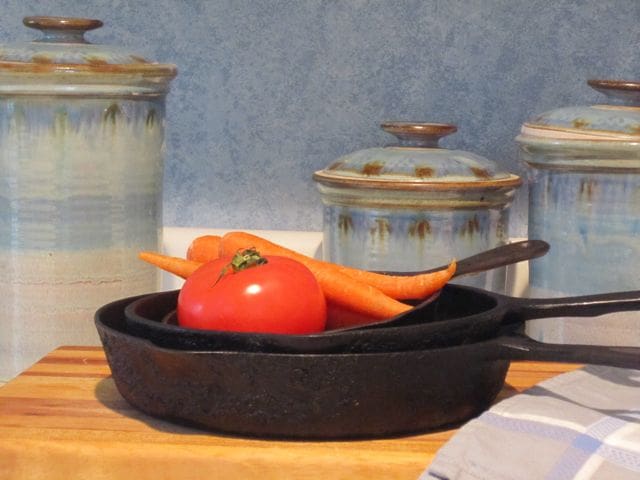
Mickey's skillets: my mom's cast iron skillets are even older than mine.
When I made the salmon recipe for the blog last week, I had to do it over for the photo because Iit was overcooked. Well, make that really crispy. Oh all RIGHT, I burned the hell out of it! It happens. But I have an excuse. Here is why.
We were back in Charleston at the time, staying in a house we rented. I do not know Madame who owns the house personally, but I do know this about her: she is not a cook, nor is he. When I opened the kitchen utensil drawer, here is what I found, and nothing else: three corkscrews.  I picture Madame waving a bejewled hand at her husband to open the wine while she pulls on her pumps, the two of them deciding where they will dine each night as they sip their sauvignon blanc.
I know this about this couple, too: they are, as we say in Charleston, from Off. There is one item missing in this sparsely stocked kitchen which any southerner worth their grits would have, even my mother who hates to cook: a big ole cast iron skillet, heavy and seasoned, charred to a jet black.
Things just cook better in a black skillet (of course mine has traveled with me to Burgundy). It’s slow to heat up, the heat is even, and anything from catfish to foie gras to french toast browns up beautifully in it. I’ve had mine since the first time I fired up a stove. I wouldn’t have burned my salmon in THIS pan. Not like the thin, aluminum, teflon-coated piece of junk that Madame has placed, unused, into the kitchen of her Charleston maison secondaire, with which my salmon was not at all pleased.
 I bought my skillet on King Street in Charleston, in the beautiful art deco building that was then the Kress five and dime. We won’t talk about how many years ago THAT was, but let’s just say that it’s well seasoned. A soupçon of irony here: one of the few places you can buy a cast iron skillet these days is at Williams Sonoma, which now occupies the old Kress building. I found an iron skillet there the other day on a bottom shelf, a step away from where I bought the first one, but the surroundings were a lot more upscale this time. Still, I couldn’t go over to the counter afterwards and get one of those chocolate shakes where they scoop the ice cream into that stainless steel shaker and whirl it around, all dished out by the Counter Girl in a mint-green apron who called you Honey. For that, I’d take the Kress any day.
Photo: Williams Sonoma is great, but I miss the Kress Counter Girls.
Now I know just what you’re thinking about that cast iron skillet. You’ve heard tell you have to season it–how do you do it? And is it true you’re not supposed to ever wash it? Well, I’m fixin’ to tell you everything you need to know about a black skillet.
There are many ways to season a skillet, but they all involve heating andd oiling it. Coat the skillet generously in shortening or lard, and heat it in a 350 degree oven (175 C) for one hour, with a jelly roll pan under it for drips. It should come out black and shiny. Cool it and wipe it down. Repeat this process to make it even better. It will continue to ‘season’ as you cook with it. To wash it, use a mild detergent or salt, but nothing too abrasive and do not soak it in water. But it’s easy to clean and you can't really burn it, so you won’t need to.
Now you’re ready to go. You can heat it ‘til it sizzles, whip up some mean fried chicken,or just cook the perfect fried egg. And you will have discovered one of the great secrets of southern cooking.
If you don’t have a black skillet, here is where to find one. I recommend a 12 inch (30 cm) as a good basic size. Bayou Classic


French Connection: The black skillet is perfect for making those beloved French sauces. Serious cooks can stop reading here, but I’m always surprised at how many folks are daunted by making a simple week-night sauce for a pork chop, a steak, or a piece of chicken. So here is a primer on making a quick sauce, and knowing this you can go your own creative way.
RECIPE: One Technique, A Zillion Sauces
This technique calls for de-glazing the pan and making a reduction, which is where a cast-iron skillet shines. Basically you need some meat, a fat such as olive oil or butter to sauté it in, and a liquid to de-glaze the pan with, which is usually quickly reduced to about half.
First you sauté the meat in oil or butter. Meat with a bit of fat on it is going to give you the best flavor for your sauce. If you’re cooking chicken, it's better with the skin on it.
When the meat is done, you will have some fat and brown bits in the bottom of your pan. You now have a fond, a French word for the bottom of a pan. If there is a lot of fat, you may want to pour some of it off. If it looks too sparse, add a bit more oil or butter as you cook the meat. For two pork chops, for example, a tablespoon or two left in the pan will do, but a bit more is OK too. You’ll get a feel for this. Remove the meat to a plate and keep warm.
Add your liquid to the fat in the skillet–which might be red or white wine, broth, vinegar, cider or other juice, or some combination of these, maybe with some brandy or bourbon or rum thrown in–and scrape up those good brown bits as you heat it up. (careful when you add alcohol, it can flame up). Boil it on high heat until it thickens a bit. You’re going to need between 1/3 and 1/2 cup of liquid to start with, for our two chop example. Watch carefully and stir it a bit. This only takes a minute or two and It can boil away quickly. Add more liquid if needed. When reduced to a sauce consistency, season to taste, pour it over the meat, and you’re done. NOTE: to make a lot of sauce, you can add more liquie and reduce it longer or more slowly, but to keep it quick and lowfat, I plan for just enough to nap each serving with a couple of tablespoons.
Instead of an acidic liquid or broth, you can add heavy cream or creme fraiche. You can boil either. (Stir in sour cream if you like, but don’t boil it).
Here are some combinations I like:
For steaks: remove steaks from pan and quickly sauté some finely chopped shallots in the fat. De-glaze with red wine, reduce, and add lots of fresh group pepper.
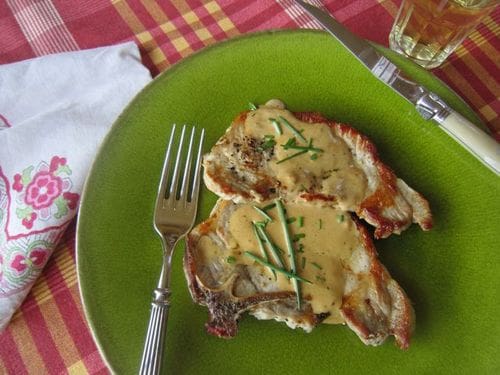
For pork chops: de-glaze pan with a bit of brandy and reduce. Stir in heavy cream and reduce as needed. Turn off heat, stir in some grainy mustard to taste. Thin it with a bit more brandy if needed. Spoon over chops, top with snipped chives (see photo).
For pork chops: de-glaze pan with white wine or chicken broth, a splash of orange juice, and a generous pour of Gran Marnier, then reduce.
For chicken: make a reduction from broth and balsamic vinegar, or use cider and add sauteed apples to your sauce at the last minute.
An Entertaining tip I love: Want to throw a pork tenderloin on the grill for guests, but still have a tasty sauce, prepared ahead? Fry up some pork chops, on the bone with fat on them. Freeze the cooked chops (dinner for another day, done), make the sauce from the fat as above, then set it aside and re-heat to serve with your grilled meat.
Roasting tip: de-glaze a roasting pan by placing it on the stove over two burners.
More sauce ideas, Dear Readers? We'd love to hear them!
 Favorite Reads: We wrapped up our Charleston visit this week, and I had to tear myself away because spring was arriving as we were leaving. There is nothing so beautiful as a Charleston printemps. Instead I'll be dreaming over a couple of books on Charleston gardens. For some history plus photos, the classic is Gardens of Historic Charleston

Unless otherwise attributed, all POSTS, PHOTOS and RECIPES on this blog copyright ©2010 Lynn McBride. All Rights Reserved.













18 thoughts on “French Sauce, Southern Skillet”
I wanted to move to Charleston in the WORST way before we headed North instead and made Newport (the Charleston of the North) our home. Even here, we will not be ‘from here’ until our great grandchildren have been here for a while. Just like Charleston! LOVE the cast iron skillet – the only way to fry!
My husband has had 3 cast iron skillets, including a small one person serving size since the sixties. He treasures them and because they seem to inspire him to cook, so do I!
Thanks for the great blog!
I’m hooked! I tried the salmon from last week and it was delicious. I love a simple to make, but delicious meal.
Sitting down at the table to a nice meal with my family is a nice way to end a hectic day.
Thanks for the skillet source tips! I really need one.
What if you love to cook…but stay on the healthy side.
No lard, etc. Is there still a benefit to buying and using an iron pan?
As long as I’m using my Mother’s iron skillet for making cornbread (the only pan to use)she is still with me! Your photos are a work of art. Sue
I love my skillets. The best places I have found skillets other than the ones I inherited are resale shops or Goodwill. Many people miss the true value of having one. Resale shops are dirt cheap.
Hi Jan,
A cast iron skillet is especially good if you’re into lowfat cooking (which I am too, sort of). For these sauces for example, I usually use olive oil, even canola oil will work. And it doesn’t take much to flavor a sauce (I never use shortening or lard, that’s just for the initial seasoning of the pan).
But the really nice thing is that you need very little oil to cook something in this pan, and it’s not prone to burning or sticking. In fact I have a new technique for cooking mushrooms: you cook them, fairly quickly, in a completely dry skillet. You add a bit of olive oil AFTER they’re cooked (just for flavor), or not. I would never attempt this in a regualr saute pan!
And many thanks to all of you for the kind comments on the recipes and photos—you’ve made my week!
Ms. McBride, it’s time for me to get a cast iron skillet. Yummayum!
ps- I’m looking for a re-tweet button, am I missing it? Southern Fried French, c’est trop bon!
pps- I’ll be on that side of the pond with mom (and possibly dad, certainly Mackenzie le roi de chiens) next year, might I offer a trade of yard work for a cooking lesson?
I was introduced to iron skillets after marrying a Southern boy. He came with an iron skillet. We’ve been married 26 years, so I guess his skillet is at least ten years older than that. We use it so much that it just sits out on the stove; we never even bother to put it away with all our other pans.
When I was taking a cooking class in France last summer the chef was using an induction cooktop and loved it. However, he said it’s not good for an iron skillet, so I guess I can cross that appliance off my list for my kitchen renovation.
There is nothing so good as a cast iron skillet, especially for cornbread; wouldn’t think of doing cornbread in anything else. However, I was always told to NEVER put soap in cast iron. AND do you have a quick way to “refurbish” old cast iron that has been mistreated and is flaking off? I did one piece with a mixture of soda and coca cola, and a wire brush, but it took forever!
Cracker Barrel is where I’ve bought my most recent cast iron skillets. They have muffin pans, cornstick pans and dutch ovens too.
I have my grandmother’s two cast iron skillets. Hopefully, my daughter will inherit my parent’s skillets when they go to that great kitchen in the sky. They are that good. Each family uses them for a lifetime and then, like the workhorse heirlooms they are, we pass them on to the next generation. I have one for meat and one for everything else. This may be sacrilege, but when I forget to take the steak out the night before and defrost it in the fridge, broiling the frozen meat in a cast iron skillet for about seven minutes per side gives me a perfect medium rare steak, seared on the outside and juicy and warm on the inside. Meanwhile, on the stove top, the other skillet is used to brown potato slices in olive oil, then I add mushrooms, harcourt vert and a touch of garlic. I cook them for a bit, then cover the pan to steam them for a bit and then brown them off just as the steak is finishing up. Just as you do, I make a sauce with the brownings. Bingo! It’s a gorgeous, fast meal. And I love my three inch deep skillet for making slow cooked Italian tomato sauce – can’t be beat.
You can buy Lodge cast iron skillets at Walmart–for way cheaper, and just as good as, Williams-Sonoma. And they come pre-seasoned.
It’s ironic that you would use the word “irony” in your article about cast iron skillets.
Yes, what would we do without our cast-iron skillets?! Cornbread just isn’t the same any other way–preheat that skillet with some oil in the bottom. Great crust!
I may have deep Southern roots, but France flavors my daily cooking just as much (first studied there in l977 and have been learning more about its cuisine ever since). I’ll print your ideas and keep them in my loose-leaf recipe binder in the “French” section, Lynn. I consider myself “a serious cook,” but would not risk skipping that section as you suggested considering! So glad I didn’t.
A decidedly NOT lowfat steak idea for a day when the weather is too bad for grilling that steak you planned for dinner: Start with a good steak. Grind peppercorns and press them into the steak. (Can let it sit for a while with pepper on it if you have time.) Heat a little butter in that cast iron skillet. Preheat oven to 425 F while the butter is melting. Sear the steak briefly on both sides. Move steak to hot oven to finish cooking for a few minutes, depending on how done you like it. That gives time to pull together a veggie or salad. When steak is nearly done enough (I check with an instant-read thermometer), remove it from oven and put it on a plate to rest a bit. Deglaze the pan with alcohol (red wine, brandy, etc.). Once all the “fond” is dissolved into the wine (and the wine reduced a bit if using wine), stir in some cream. Fast, easy, delicious!
Ah, Charleston! Spent a week there in 1997 and still fondly remember it.
And while I know Southerners think only they truly understand cast iron skillets — and many other things — we Westerners adore them, too! (Our ancestors couldn’t have survived the trek out here, whether by covered wagon, railroad car, or the 57 Chevy, without one!)
Leslie, in Montana
Hi, Lynn. I have been lurking on your blog for several months now and enjoy all your posts.
I agree with you about cast iron skillets – there’s nothing like them! They can also be found at hardware stores and athletic/outdoor stores(probably much cheaper than W-S).
As for the seasoning and care of your iron skillets, I recommend this video, done by Judy Walker, the food editor of the Times-Picayune newspaper of New Orleans, LA.
http://videos.nola.com/times-picayune/2011/02/cast_iron_skillets_how_to_seas.html
I like your idea of seasoning them in the oven, but cleaning them with salt is a big no-no, as it will eventually corrode the skillet. I have heard this from experts, one of them a member of the “Dutch Oven Society”, another a museum conservation expert.
My rule is: There are two things I NEVER wash with soap – my face and my cast iron pots!
Enjoy the video. I do so enjoy your blog. I have been to France numerous times and love it… have many dear friends there. Wish I could do what you and your husband are doing!
Sincerely,
Augusta Elmwood
New Orleans, LA
Hope Madame does not read your blog, she will be throughly po’d that you dared complain about her lack of kitchen accoutrements.
Just remember, Lynn, that your French neighbors probably consider you “from Off” as well!