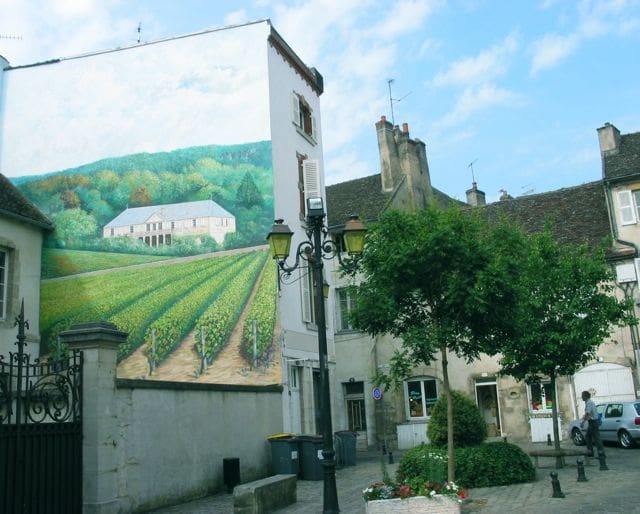
Photo: A street in Beaune, the wine capital of Burgundy
Every year in Beaune they hold a very famous wine auction, attended by the true pros, who are savvy and also flush with euros. No, we’re not invited to that, but at the same time, they have an exposition of all the wine merchants in Burgundy, open to the common folk. Ron and a couple of friends went up one year to do some serious tasting.
Each merchant at the expo had a booth, displaying their wines, and glasses for tasting. How many booths were there? Hundreds. How many wines were there? 1400. 1400! And those were just BURGUNDY wines! How many booths did Ron and company make it to before they were sipped out and done in? Maybe three.
So you think we’re going to become Burgundy wine mavens? Not in this lifetime. We can’t even taste them all. But that won’t stop us from making a valiant effort.
 I’m going to attempt to give you a one-minute crash course in Burgundy wines. Red wines in La Bourgogne are principally made from Pinot Noir grapes. Burgundy reds in general are very fine, and trés chere; the inexpensive Burgundy reds are not so intéressant, as the French would say. The fine reds are generally made in the Côte d’Or, north of us, around Beaune.
Most of the white wines in southern Burgundy, on the other hand, are marvelous and affordable. They make great ones in our neighborhood, in the Mâconnais and the Chalonnais, where the cépage (grape) is Chardonnay. Photo of our friend Joan: wine's a hot commodity around here.
Here is an interesting factoid about France: you buy wines in the region where they’re made. In the local stores you can find the odd bottle from another region (and the very odd bottle from another country), but to stock your cave—and most everyone has one–you go to that region to get it or you have it shipped to you.
Now about that house wine. Our Burgundy house white wine needs to be affordable, versatile, and available in the area. Choosing a house wine is a topic of much discussion and tasting. Often folks buy their house white from a cave coopérative, which buys grapes from local growers and adds their wine-making expertise to the bottling and marketing. Ron passes some of them on his daily bike rides: Viré Clessé, Charnay-les-Mâcons, Buxy. You have to taste many to find your favorite wines at your chosen price point; and since these are agricultural products, your answer this year may not be the answer next year. We choose our house red from the Côtes du Rhône, a great wine region just south of us with fabulous, good value, reds.
Thirsty yet? Coming up in this occasional series, posts on blind tastings and stocking the cave. Meanwhile, to go with your white Burgundy:
RECIPE: Roasted Asparagus Soup

Makes soup for two, or for 4-6 if serving with aperatifs.
- 1 bunch green asparagus, trimmed
- 1 medium potato, peeled and cut in small pieces
- 1 small onion, peeled and quartered
- 1 tablespoon olive oil
- milk or light cream
- chicken broth
- white wine
- cayenne pepper
Heat oven to 350 degrees (175 C). Put asparagus and potato in a roasting pan and toss with olive oil. Add onion, season with sea salt and pepper. Roast until vegetables are tender, 20 to 30 minutes.
Put vegetables in a saucepan and add cream and/or milk to cover. Purée with an immersion blender.* Thin as needed with some chicken broth and a generous splash of white wine or lemon juice. Add a dash of cayenne pepper, taste to correct seasonings. Serve cold or hot, garnished with sour cream or creme frâiche.
*Those clever French cooks are onto something: nearly all of them have an immersion blender,especially important since they prefer their soups puréed. Forget pouring everything in batches into a blender or food processor; this is a wand that you just stick in the soup pot, and press a button to blend. The blade pops off and goes right into the dishwasher. Tellement facile! Here's a good one: Cuisinart CSB-76BC SmartStick 200-Watt Immersion Hand Blender, Brushed Chrome
Interested in staying at the château? Nicole and Pierre have now fixed up a couple of extra bedrooms as a gîte. Nicole will give language lessons on request too. Go to http://www.lessaveursduchateau.fr/.
If you want to stay in a charming little stone dollhouse in the countryside, try my friend Sabine’s gîte near Cluny, http://www.maisonpomme.net/.
Favorite Reads: Burgundy wine lovers who want the definitive word on the subject will want to get Clive Coates The Wines of Burgundy. If you want a handy reference guide to French wines and a great travel companion, we really like Robert Joseph's book, French Wine (Eyewitness Companion)
In the Comments this week: Don't miss Julie's Ode to Strawberries, fabulous! And Thea, thanks for the reminder about David Sedaris, whose book about learning French, Me Talk Pretty One Day
Unless otherwise attributed, all POSTS, PHOTOS and RECIPES on this blog copyright ©2010 Lynn McBride. All Rights Reserved.












7 thoughts on “Life in Wine World”
Asparagus season is almost here. Nothing comes close to truly fresh from the market asparagus. Now I have a new recipe to try. Hmmm, I’m pretty sure I can dig up a pretty bowl and spoon to eat it with :~)
How do you do the lovely swirling pattern?
Perfect timing, Lynn! Asparagus will be popping up in our garden soon here in Northern NY. And you’re so right about the immersion blender.
bonjour Madame Silver Magpies: this is the first time I’ve swirled, and it was so easy! Put a couple of dollops of sour cream or creme fraiche on top. Take a knife and run it back and forth, gently, through the cream. Done! And Carol, I’m so jealous you’ve got home-grown asparagus. I’ll have to try planting it.
Ciao Bella! It’s great to see the asparagus soup made with the green guys. We’ve lived around the “spargel” region of Germany for years, and it’s hard to get anything but the ever-so-delicate-and-way-more-chic white stuff. Don’t get me wrong, I like white asparagus, but I find the flavor gets lost in a soup. Plus you then have to whizz up something green to make an ever-so-delicate-and-way-more-chic swirl to go on top. Feeling inspired to make a run for the border to stock up on green asparagus and chardonnay. Merci bien!
Hi Cynthia,
I’m with you! the French fondness for the white stuff eludes me. But the green is my favorite vegetable! It grows wild in the woods here too, but very skinny, tender stalks.
I made asparagus soup a few years ago and pureed it (almost) with an immersion blender. The asparagus was so fibrous that it kept choking the blender and ultimately I stopped short of blending the asparagus completely. The fiber persisted longer than my patience.
Perhaps the problem started with my character flaw of frugality. I cooked entire spears (that is spears with their broad underground white butts, rather than just the green tips). I think the butts contributed the wads of fiber.
My remedy was to strain the soup, which left me with watery asparagus soup and a bird’s nest of fiber to send to the garbage can. Next time, I’ll use only the green tips. Does that sound right?
Hi Mark,
I’ve made this successfully several times, maybe it’s just the tender French asparagus, don’t know. Some people peel the stems of asparagus, but I don’t. I take the stalk, bend it where it naturally breaks, and throw away the stem. You don’t have to use just the tips, but if you cook that woody stem, you will surely have fiber. Hope this works!