It is nearly impossible to buy my husband a present, one that will really please him; maybe you know a guy like this too. But I hit gold on his last birthday, with a gift I made myself in five minutes for a few euros. Of course it had to do with his favorite subject, wine.
To be ignorant of wine here in Wine World is to be a real no-account. One of our favorite ways to sharpen our palettes is to have a blind tasting. This is fun for novices and connoisseurs alike, since there are no right or wrong answers.
You can have a party based around a blind tasting, or do as we usually do, which is to pull a sampling of wines and taste blind, which we do almost every time we have a few guests for dinner.
A serious tasting would involve wines from the same region, year, and cépage (the grape variety), and one would take notes on various characteristics: the color, the nose, the legs, the flavors, etc. Of course you would spit the wine out afterwards. We’re not that serious, though, so here is how we do a it: Ron picks from three to five wines with some common thread. The idea is to discuss them and then pick a group winner. He makes a list, then covers the bottles to hide les étiquettes, the labels. We taste a bottle at a time, discussing the flavors, the nuances, and our preferences. No spitting–we drink it right up! Then, each guest picks a favorite. (If you have more than three bottles, you might need to give everyone paper and pencil). Then we unveil them, and declare the winner. We continue drinking them for appératifs, then they all go on the table with dinner.
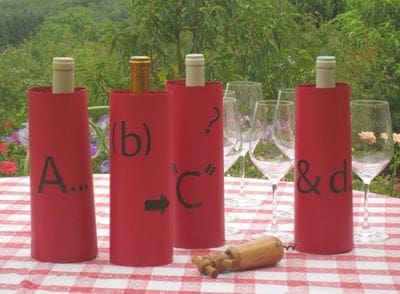 Now back to that gift. Ron always taped paper over the bottles when we had a tasting, so I decided he needed something classier. At the craft store I found some heavy paper with a ridged back that bent easily. I glued velcro closures on the inside and added some decorative lettering. Et voila, instant wine covers to make that wine blind.
One little story for you: At Christmas dinner last year, we were a dozen or more chez nous at the château and we started off the festivities with a champagne tasting. Nicole, our châtelaine, has a special champagne that is her favorite, so we often serve it at Christmas. We put one bottle of that in the blind tasting, curious to see if she could pick it out. Ron announced that we were only tasting Champagnes, not crémants (crémants are French sparkling wines made just like Champagne but not in that region, so they can’t bear the name. The taste, though, can be quite similar).
 But Ron was naughty and secretly threw a crémant into the mix. Not only did Nicole correctly identify her favorite Champagne, but both she and Pierre immediately identified the rogue bottle as a crémant, despite being told it was all Champagne–while the rest of our international crowd did not. Now THAT is impressive. We’ll never catch up with those clever French!
RON’S CORNER: “No matter which wine the group chooses as the best, the real winner in our tastings is revealed during dinner–it's the bottle that gets emptied first!” On his criteria for selecting a group of wines: “I raid the cave, and see what I can find. Typically you would taste wines from the same variety, year, and appellation. But you can choose any theme you want. You might taste several random wines that are all the same price, to pick the best value wine, for example. Or choose several wines of the same cépage, but each from a different country."
Favorite Reads, and a grape flick: If you are at all interested in wine and you haven’t seen it, you must order this film TODAY: Mondovino

In the Comments this week: LOVED all the pesto ideas! Beth does an arugula and walnut mix, Katherine uses almonds, and Jenny uses sunflower seeds—that’s a new one! Patricia adds creme fraiche to pesto and pasta, got to try that. Kristin puts it over salmon, served over grits, a true Southern Girl. The most interesting idea came from Cynthia M.–check out her creative solution for keeping the green color bright. And welcome to Judy, another Furman alum.
Our Reader's Blogs: Mark Kane is the groundskeeper at Your Garden Show, a must-see if gardens are your thing; you can find Mark's beautifully written blog posts there, and much more. At My American Market, Anne-Clair Bocage sells American food to French residents, and also has an interesting newsletter for Francophiles.
Unless otherwise attributed, all POSTS, PHOTOS and RECIPES on this blog copyright ©2011 Lynn McBride. All Rights Reserved.
8 thoughts on “Tasting Blind, A Painless Education”
Lynn,
You are so right about Mondovino! We first viewed it via Netflix. Researched it to know more and found that the movie is a distillation of a 10 hour miniseries. Immediately ordered up the series from Amazon.
There are 4 discs, subtitles in English/French/Potugese/Spanish. Each 1 hour episode stands alone, is it’s own story. If your readers intend to buy the movie, they may want to spend a wee bit more and buy the series…click on the Jonathan Nossiter hyperlink, on your Mondovino/Amazon link and it will take you to the series.
Your wine bottle covers are a wonderful idea! Enjoy your blog…
Bonnie
My sister, the recently retired CEO of St. Supery Winery in Napa, CA, responded to my praise for the documentary Mondo Vino by declaring that she and her peers thought it was a hatchet job on the Mondavi clan and its attempt to establish vineyards in France. A blatant hatchet job, she may have said. Surprenant.
I saw it differently and really liked the movie, mainly for its footage deep inside the business, both in Europe and the U.S.
Apropos of blind tastings, have you heard that many of us can’t tell a red from a white?
Hey Mark – it’s your sis. Like you, I really enjoyed Mondovino; there were some truly hilarious moments and the filmmaker captured the personalities (egos?) of most of those he interviewed, at least the ones I know. I also think it was a bit of a hatchet job on large producers everywhere, the carefully edited message being that only small, artisanal wineries make authentic wines. Most of us in the wine business are grateful for the huge contributions to quality improvements that Robert Mondavi, Piero Antinori and other leaders have made.
Thanks for linking me to this blog!
Dear Lynn
Nothing goes well with a good red than some fried okra, new potatoes, and fried quail (or chicken). Do you grow okra there like a good Charleston girl?. Have you tried any wine from Domaine Rouge Bleu the vineyard owned by Kristin Espinasse and her husband Jean Marc from Orange in Provence. She writes the blog French-Word-A-Day. We have 50 Avacado buds on our tree out back here in 105 degree day in Palm Beach.
Like any good documentarian, Nossiter let people speak for themselves. It is up to the viewer to draw your own conclusion. The filmmakers went to the town in France where the Mondavis wanted to start a vineyard and spoke to both sides; pro and con. To me, the Mondavis are a classic Greek tragedy. The father leveraged himself so much, when Parker gave a bad review and demand declined, he lost control of his own company.
To me the larger point of the movie Mondovino was “terroir”. Californians believe you can plant any grape, anywhere, irrigate, and manipulate the winemaking process, to achieve the desired “product”. The French plant a particular grape in an area where they know, historically, it does well. Irrigation is prohibited by law. That gives French wines variations from year to year depending on the weather. They believe that the land the grape is planted on gives the wine it’s character.
Take Burgundy reds; they are all Pinot Noir. Yet, the different plots they are planted on result in amazingly different wines. That is terroir.
Another good book on French wines is Kermit Lynch’s, “Adventures on the Wine Route”. It is a fun read!
Bill and I just got back from Sonoma where we hit several marvelous vineyards big time. I have always been a major wino (albeit with discriminating taste- I don’t do swill), but I never had an appreciation for the many subtleties. I love the blind taste tasting and I am sure we can do it here with lobster and a clam bake as the pairing. Thanks again for divine inspiration!
Wow! Nicole and Pierre are very impressive!
I’d love to go on a tasting, great present idea 🙂
Going to put this atricle to good use now.