 I’ve avoided this post for quite a while. I like to keep things upbeat, and our life in France IS upbeat and wonderful. But after living here for 10 years and visiting for many years before that, it’s impossible to ignore the problem: The long revered French restaurant cuisine is going straight down the tubes. It’s shameful, really. Happily, there’s a move afoot to correct it. (PHOTO: The French are pouring their fabulous international reputation right down the drain).
Sure, at the very top level, French cuisine is unbeatable. But at lesser restaurants and especially at bistros and brasseries, they’ve mostly switched over to commercially prepared dishes. Noted Paris chef Xavier Denamur says the number of French restaurants serving ''industrial fodder'' is over 70%! Not just opening a can or pulling ingredients out of the freezer, mind you, we're talking entire meals–from meat to veggies to sauces to desserts–that are pre-prepared, and then zapped when you order. It’s impossible to believe that the gastronomically-obsessed French are putting up with it.
It’s a perfect storm of hard economic times, modern food technology, and the new fast-food lifestyle. Restaurants can make huge profits by serving industrial food. They don’t need the expense of a real chef, and they can cut down on all of their labor costs, as well as on food waste.
 A small but significant move toward change: Chef Alain Ducasse, along with a slew of other shining food celebs, has started a new label that will be awarded to restaurants featuring fresh food prepared on site. The private group, College Culinare de France, will award plaques that restaurants can post (at right). "Most restaurants ‘only do industrial cooking’, " he says. "These days, the average person has no idea what they are in for when they open the door to a restaurant.” He adds that to be awarded the new label, restaurants will be required to have an in-house chef and not "someone who reheats a frozen bag".
 For a foodie like me, this problem is the end of civilization as we know it. So, how to avoid these microwave mills in France? Look for the new plaque, and search the Michelin guide (though many think it contributes to the problem). And, when you see a menu at a small place with like a thousand items on it, you can be darn sure they’re not cranking out everything by hand. Search out places with the daily menu on a chalk board, and very few à la carte items. And here is my other solution. Every time I go in a restaurant or bistro, I’m asking: what’s homemade and what’s industrial on your menu? (even though I don’t really have much hope of getting an honest answer). And I’m making it clear which I’m choosing. If the consumers don’t demand change, who will? I hope you’ll join me in taking them to task. And I’m VERY interested to hear your experiences on this subject, please do share! (PHOTO, A French exception: A restaurant in Nice showcases the chef's fresh veggies and herbs right out on the counter).
Now, let’s show them how easy it is to cook up something fresh and fabulous, and easy too!
RECIPE: Spicy Pork Roast En Croute
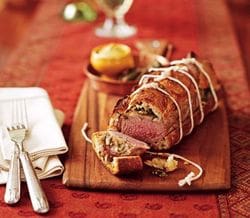 En croute is a French term meaning something wrapped in a pastry or crust of some sort. This pork tenderloin is wrapped in a low-brow crust that’s easy and delicious: a crunchy baguette.
This recipe comes from the wonderful chef, Joanne Weir. I’ve followed her basic recipe, but kicked the flavors up a notch. It’s my company main dish this year, and it’s fun and unexpected. It couldn’t be simpler to make. Carve it à table for a nice presentation. (Photo courtesy of Traditional Home magazine).
Serves 8
- 2 pork tenderloins, total of 2.5 pounds
- 1 thin, fresh, good quality baguette (the length and width of your tenderloins)
- Olive oil, grainy mustard, soy sauce
- 3 large cloves of garlic, minced
Spice mix:
- 3 teaspoons chopped fresh rosemary
- 2 teaspoons snipped fresh thyme leaves
- 3 teaspoons chopped fresh sage leaves
- 2 teaspoons snipped fresh chives
- 2 teaspoons fennel seeds, crushed
- 1 teaspoon fresh ground pepper
- 2 teaspoons sea salt
The morning of:
Season tenderloins lightly with salt and pepper. Heat 2 tablespoons of olive oil in a skillet over medium high heat and brown the meat in oil for about 8 minutes, turning frequently and reducing heat a bit as needed. Pour off any pan drippings and save for later. Set tenderloins aside to cool slightly.
Mix 3 tablespoons of olive oil with a tablespoon of soy sauce, a teaspoon of grainy dijon mustard, and the garlic. Roll the tenderloins with the mixture, on a plate. Leave them in the fridge for a few hours, turning them over from time to time.
A couple of hours before you will cook them, drain the excess oil and coat tenderloins with the spice mixture. Slice the baguette lengthwise, evenly. Scoop out most of the mie, which is the soft interior of the baguette, and discard. Set aside. Now you’re ready for your last-minute prep.
When ready to cook, pre-heat the oven to 375F (190c) and brush the interior of the bread with 3 tablespoons of olive oil, combined with any leftover pan drippings. Place the tenderloin inside the bread. Scoop up any spices that did not stick to the tenderloin and spread them inside the baguette. Tie the baguette tightly about every 3 inches with kitchen string. Put it on a baking sheet and pop it into the oven.
Here’s the tricky part: you can’t easily cut into it to be sure it’s done, so you need to carefully check the internal temperature with a Quick-Read Thermometer
Cut into slices (a bread knife works best) and serve–no sauce required. I like serving this with baked cheese grits and roasted mixed bell peppers.
In the COMMENTS, about coffee and tea: Natalia talks about good tea bags she got at Mariage Frère, the famous Paris maison du thé. I would buy their tea just for the beautiful packaging! Sip a cup while you check out their pretty website. Chris, Sandy, and Jonelle are all drinking noisettes: it must be a trend! Une noisette is a single-shot expresso, served in the usual small cup, with just a dollop of steamed milk. Rich but without the heaviness of a café au lait. Noisette means hazelnut in French, and the coffee is called this because of its nut-like color. And Caterina, I am absolutely with you, when it comes to feeding kids!
Favorite Reads: Want to read more about the crisis in French cuisine? Try Au Revoir to All That: Food, Wine, and the End of France














22 thoughts on “Is French Cuisine in a Downward Spiral?”
I agree this cuisine issue is prevalent in restaurants all over France, and it is hard to know how what you are now being served is prepared. During my last trip to Paris, I even asked a serveur if the onion soup was homemade, which Attention! can also be interpreted as asking if it’s made in-house, rather than from scratch. Great post!
Thanks for this information! I had no idea that restaurant food in France is in such a state of decline. The pork recipe looks wonderful. I assume that you bake the grits early at 350 and reheat them at 375 when the pork is cooking. If so, for how long?
I know that here in Arles, it is widely known that nearly ALL of the restaurants on the Place du Forum, which is the hub of cafés here (and where Van Gogh painted Nuit Etoilée) use frozen dinners from Metro in Nimes (part of a chain of supermarkets open only to the industry). And sure enough, if you pass in the alley behind all of these restaurants there is no garbage except for boxes and MAYBE a few empty “cagettes” of lettuce for salads–since that can’t be faked!
I love to go out to eat but why would I pay for frozen food when I can cook far better at home? Sure, we have some excellent Michelin recognized restaurants but I can’t afford to go to them…Let’s hope things start to change!
Well this IS upsetting news. I shall now pay attention to what is being served. You said you now ask what is homemade and what is industrial….since I’m a foodie too, I need to know how to ask this in French….if you wouldn’t mind a little French lesson here 🙂 AND fortunately, GiGi’s Pizza in Golfe Juan DOES make all of their own food – I watched one of the cooks, one night, rolling out the homemade pasta on a machine. Thank goodness since GiGi’s has the best pizza around here 🙂
Lynn, my daughter and I ate at a restaurant on the port in Toulon, yesterday. When it came time for dessert, we stared at the plastic-looking offerings on display. Just in case, I asked my 15-year-old: Did you want dessert? She shook her head and we agreed to have a scoop of ice cream (from the Haagen Daz shop across the street!) P.S. On another occasion I was eating pizza with my husband when he called the waiter over. “This was frozen, wasn’t it?”
How unfortunate that things have become so bad that an “award” had to be created to help reverse the decline. We had lunch at a restaurant on the boardwalk in Cassis and the mussels “on the half’ were shriveled up like raisins! Either they were nuked or the kitchen was irritated with our just-before-closing-time order and wanted to let us know. Then again, on a recent trip to Paris, we ate at many restaurants featuring open kitchens, where diners could see the cooks at work. I’d like to think we chose well, but I will definitely be on the lookout for “fakes” next trip…
Thanks for another informative post! x Katie
Hi Kiki,
Just say “Dites-moi ce qui est frais et cuisiné sur place par le chef.”
Oh! This is very sad to hear. I have not made it to France (yet) but have often dreamed of the (supposedly) wonderful food there. I guess the awful truth of prepared, sub standard food created simply for profit like we have in the US has crossed the ocean. It’s just another way we are destroying our planet.
I will continue to make almost everything from scratch. Now…I will try mayonnaise this weekend. I know it’s very easy!
Nicole, merci pour votre mots a dire au restaurant. I’ve written them in my little Eiffel Tower notebook to take with me on a hopefully upcoming trip to Paris. Lynne, thanks for writing about this. I had no idea! I am sharing with some friends who love France.
At least a Frenchman can call another Frenchman out! Good for Jean-Marc!
It’s very good advice to look for places with chalkboard menus outside, and only a few items on offer. Thanks also for the French phrase to use when asking about the menu, Niicole!
Wow Lynn, this one really hit a nerve, didn’t it?!?! On our last trip to France we found it difficult to find good food in Paris at any bistro or brasserie, and the same in Pau and Montpellier! We thought our tastebuds were changing, but apparently they’re even sharper than we thought! The good news is that in Lyon we had excellent meals almost everywhere we went, prepared with the love and skill one has come to expect (and appreciate) in France. So take heart fellow foodies, there IS still good food in France, especially in the gastronomic capital! Sadly, we must keep the pressure on those who are ruining the traditions of la cuisine francaise!
Lynn,
You’ve answered some questions from our recent trip, though for the most part, we enjoyed our fare–usually at a restaurant serving two “plats” and little other variety. But we did have an occasional quick lunch at a counter where we were very disappointed with the “cardboard” fare. I agree with the comment noting the travesty of having to create a new designation for chef-prepared meals. Food is a significant reason for our love of France. We’ll be back, of course, but will be using Niicole’s translation of the inquiry about whether or not the chef actually prepared the food. We gravitate toward less expensive restaurants and hope we don’t have to change that habit.
Chris
Lynn, thank you for this interesting and thought provoking post; one which affects all of us who enjoy good food.
You named one major reason why my husband and I don’t dine out as much as we once did (besides the fact that I love to cook).
The last time we decided to visit our favorite (French) place,we discovered a noticeable decline in the quality of the cuisine. We knew the waiter for some time and asked him to be honest about this. (He was). The final blow was admitting that the souffle was made from a mix(!)
What a pity.
Well, we’ll always have wonderful (delicious) memories to remember.
What a happy way to start the weekend!
In 2000, we were on a nine day trip based in Aix-en-Provence. The breakfasts were all good, but there were only 2 memorable meals among the lunches and dinners. One was in Rousillion (tasted like my mother’s cooking)’ and one was in Arles. The rest all tasted like plastic.
My husband I are fortunate to have French friends who are accomplished home cooks so our restaurant experiences during our annual trip to the “Hexagon” are limited. However last September we more or less ate our way through Normandy with some of these friends. While most of our meals were sublime, your post explains a completely inedible meal we ordered at a restaurant in Honfleur. From now on, if I don’t have a credible recommendation for a restaurant, I’ll only eat there if they have an open kitchen.
Excellent if alarming post Lynn, thanks. Will definitely attempt to be more discerning in our restaurant choices. Bon weekend.
Your pork roast recipe looks divine!
The most disappointing meal I had was at a ‘chain’ restaurant outside of Paris (I believe it was Maître Kanter). Everything was unmemorable, except for the HUGE gob of smooth white mashed potatoes (no texture at all) that took up half of the (oval) platter on which I was served. I ate everything on the plate except the potatoes. I hope that told them something. The decor of the restaurant was nice — country rustic — but I wish they had spent the money on a real chef and less elegant surroundings. Of course we realize that the ‘real’ meals (prepared by a chef) don’t come cheap.
An interesting post, Lynn, though it is very sad. If we can’t get “real” food in France the world is indeed in trouble. When profits become more important than the product and reputation of a restaurant, many of us will simply stay home and cook. My husband and I will be visiting France again this week. We will use your tips and look for the chalkboard menus and the new label. Word-of-mouth is also more important now, and it will help that we have loved ones who live in France.
What a shame Lynn to hear of this. I’m frankly quite surprised since I’ve never been to France. I hope to someday so this is quite good information to know. That recipe sounds wonderful, a keeper for sure. Thank you for this timely information. Your photos are so charming as always.
Alas, happening in Italy, too. Depends on the region, type of restaurant, and intuition…look for Slow Food signs.
I have been a Frère Mariage fan for years. Their teapots are gorgeous, too, and cost slightly less than a diamond neckless.
A very good post. As a foodie and owner of a French bistro near San Francisco and a home in Provence, I have been invited and/or walked into a lot of kitchens in the Vaucluse region, the latter to thank the chef for the meal, and I have never seen one frozen prepared dish being microwaved. And we eat out a lot! I am not talking about Michelin starred restaurants although some are Bib Gourmand. True I check the menu to look for the same things you suggest and we don’t at the places that surround the main tourist square or along the port in places like Cassis.