
I’ve always been fascinated by the often colorful French blasons, the heraldic coats of arms that are a part of European history. Originally used by medieval knights (so they could tell just who was hiding inside that coat of armor), their use later broadened. Individuals, families, monarchs, cities and regions used them as personal symbols. I suppose it was the origin of what we now call ‘branding’. Certain rights sometimes accompanied blasons, and most were registered in some fashion along the way. A coat of arms is typically in the shape of a sheild and may have an accompanying motto.
 Even today, all French cities and regions have their own blasons which reflects their particular history. To the right is the official blason de Paris. Fleur-de-lys, crowns, and laurel leaves are common in coat of arms designs. The motto translates as: Il est agité par les vagues, et ne sombre pas. "She is tossed by the waves but does not sink".
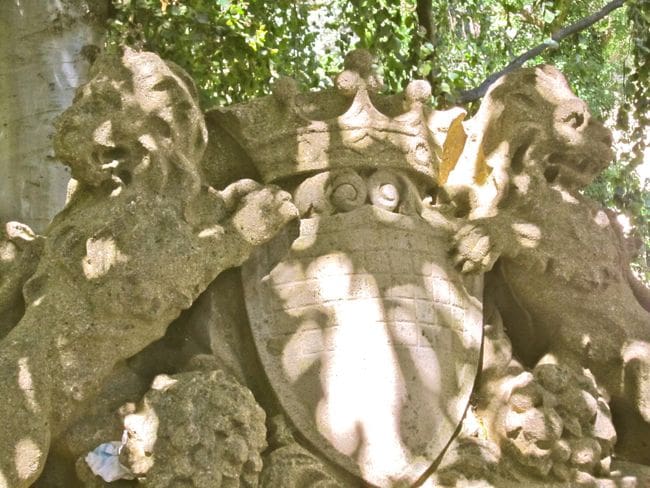
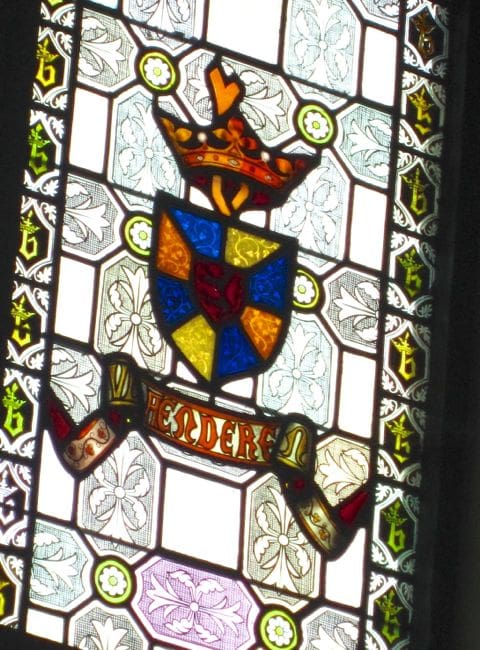
For me, les blasons are camera-magnets, so above and below are are a few I’ve snapped over the years.
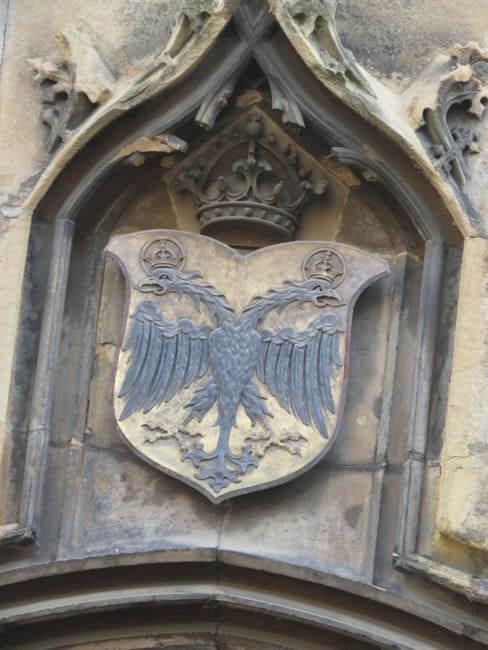
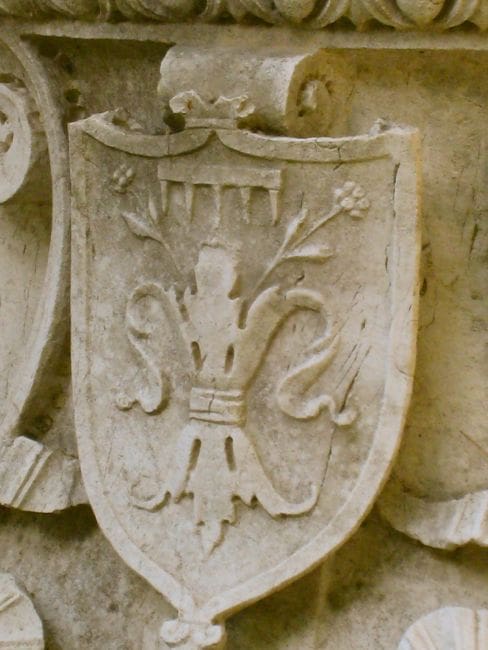
PS If anyone knows the signifcance of the two-headed bird above, I'd love to hear it. I've got a very similar carved blason that I bought at a flea market in Spain, and I'd love to know the story.
In the COMMENTS: RE our recipe– as Natalia says, there’s no better combination than potatoes and bacon. But Vagabonde, not to worry, the potatoes are made with milk instead of cream, so they’re healthy, right? (love the August Thanksgiving!) Or do as Gretel will do in Oz, and pair it just with a salad. And speaking of recipes, and healthy ones, Suzanne makes biscuits and pancakes with yogurt—have to try that!
Reminder: When you're doing your Christmas shopping don't forget How to Learn a New Language with a Used Brain
Hope everyone had a happy holiday! And thanks for sticking with us, despite our winter schedule of twice-a-month postings.

12 thoughts on “What, You Don’t Have Your Own ‘Blason’?”
http://en.wikipedia.org/wiki/Double-headed_eagle
The two headed bird is actually a two headed eagle and it represents the conjoining of two forces. Other than that I can’t go any further with an explanation.
I am happy to say that I do have a French blason and it is for the name Jambon.
The two headed bird is actually a two headed eagle and it represents the conjoining of two forces. Other than that I know nothing more about the translation.
I’m proud to say that I have a French blason. It’s for the French surname Jambon.
Wikipedia says “The double-headed eagle is a common symbol in heraldry and vexillology. It is most commonly associated with the Byzantine Empire, the Holy Roman Empire, the Russian Empire and their successor states. In Byzantine heraldry, the heads represent the Emperor having authority over both secular and religious matters…”
If I had a blason it would probably be two whisks (argent) crossed over a field of wheat with a chocolate border 😉
I always thought the two headed golden eagle was the Hapsburg dynasty synmbol
If I remember correctly – The Habsburg Monarchy took on the Double Eagle Crest to show the ties between the Imperial Title(mostly members of the Habsburg dynasty)and the Habsburgs.
Have always been attracted to blasons as well–and often see them on entrances and walls in France-thanx for this swell reminder.
When we were in Russia, we saw many instances of the double-headed eagle. Apparently the idea was taken from the Byzantine empire in the 15th century and adapted for the Russian Imperial coat of arms. If you check wikipedia, you will see several steps in the evolution of this symbol. In Russia it was closely associated with the Romanov tsars.
I wouldn’t miss you for the world!
Wow,Lynn,what a great post today!
I’ve always loved blasons and found their histories fascinating;
these especially capture our imaginations!
Thank you!
It is called Lo Stemma in Italy, and the Italians are very attached to theirs too. I have my own problems with them at the moment! A friend asked me to paint a still life containing two references to her family. One is a raven, her father’s family symbol (and I am unsuccessfully searching for a stuffed raven to work from), and the other is her mother’s ancestor Paulina Borghese, who is reclining stonily in the Borghese museum, which doesn’t allow artists to make sketches. I don’t like to work from photos….mamma mia!
I like blazons too. I used to collect them, in “feutre” (English?) and sew them on the sleeve of one of my jackets. Then also I used to have the Cambridge blazon on my blazer when I went to school in England. I think the double-headed bird in heraldry could mean the same as it does for the double-eagle of Imperial Russia. It means power over state and church, or over the people and the clergy – maybe to show a family all powerful, no? and to keep your blazon with a double-headed bird may mean you still believe you have “power” ah!