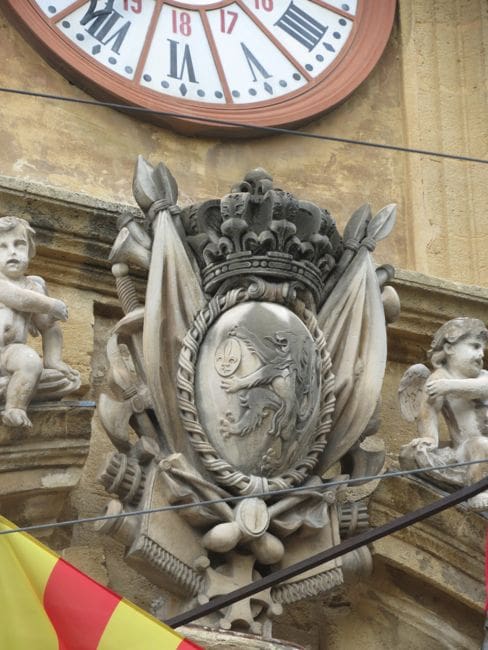
Photo: In Salon de Provence, the Hôtel de Ville has a clock with both 24 hour and 12 hour time.
They say each culture has it’s own definition of time. From the punctual Swiss to the laid back Spaniards, time has slightly different meanings.
The French are fairly precise when it comes to time (well, unless you’re talking about an ouvrier’s arrival), though there was one thing that puzzled me when we first moved here. If you ask a French person when they can come by and they say au début de l’aprés-midi (start of the afternoon), as they often do, they mean this: right after lunch, plus the time it takes to get to your house. Which to us would be vague, but for the French, lunch is 12 to 2, so this is in fact a specific time.
So if you want to be à l’heure (right on time), then for your French lesson du jour, let’s look at some interesting expressions involving time, French-style. By the way, in talking about time, the French generally use the 24 hour clock, though they sometimes use the 12 hour clock time as well.
–We all know à bientôt (see you soon) as a parting expression, but you often hear à toute à l’heure (literally, “at every hour”). Which is even sooner, like “I’ll see you shortly”. It can also mean “a little while ago”.
—Le quatre heure, 4:00, is the universal expression for snack-time for kids (OK and maybe some of us adults).
—L’heure cruese is a quiet or dead time, when nothing much is happening.
—Les heures de pointe are high traffic times, as with cars or trains.
—Les dix minutes de politesse, or “the 10 minutes of politeness”, means you should arrive between 5 and 15 minutes late to dinner to allow your hosts to get their act together.
–Quand c’est l’heure, c’est l’heure is an expression meaning: the moment is right, just do it!
–Chercher midi à quartorze heure (literally, to search for noon at 2:00) means to make something difficult, to make it harder than it has to be.
—Il était une fois is how the French say “Once upon a time…”.
And when it comes to sleepy-time:
–Une nuit blanche is a sleepless night, or maybe you never got to bed.
–Faire la grasse matinée means to sleep late.
And finally, take care if you toss this expression around:
—Le cing à sept (5:00pm to 7:00pm) refers to the period when illicit affairs take place, that little tryst between boulot and dodo (work and sleep).
We came up with the expressions above in my French conversation group. We'd love to hear them, if you have more!
In the COMMENTS: Does anyone have a great house rental in Provence to recommend to Debbie? Natalia, aioli would be great with a bouillibaisse. And Jane, that meal will inspire envy–so fresh, so French!
Favorite Reads: Jeff Steiner has a very useful website called Americans in France, and I had such a laugh this week over his newletter post, called "12 Things to do in Southern Burgundy That You Can't Do in Paris". And book lovers and collectors, if you haven't discovered the book I'm reading, and loving, at the moment, do check it out: The Bookman's Tale: A Novel of Obsession, by Charlie Lovett.







7 thoughts on “All in Good French Time”
Thanks for the lesson. I’ll listen for some of these when I’m there. I hear à toute à l’heure all day, every day. My husband is so dedicated to being on time here that I’m sure he flusters our French hosts sometimes when he shows up on time. Some habits can’t change.
What about quinze jours, meaning 2 weeks.
I am enjoying your blog, and especially this post. I will order your book, because I too have a used brain! Anyway… what about “à tout de suite”? I learned this one a few years ago. I also learned that you do not pronounce the “de”, running it all together, as they often do around here. ( I live near Uzès.)
As far as rental property, try http://uzesvacationrentals.com Full disclosure… my daughter’s business.
Thanks for the book tip. I will order through your website.
A bientôt!
Rainey
The expression “l’heure bleue” refers to dusk. Love the sound of that one!
Sandy
And you forgot “j’arrive!”
I love it when the folks at “my Paris hotel” say, ” A la prochaine/a la prochaine fois” when I’m departing. (Until the next time)
Lynn,this another fun (and educational for this woman’s used brain!!)post.I remember my parents reading stories to me that started with”Il etait une fois”;hadn’t thought of it in ages and just wonderful to recall!Thank you!
Is there a reason ,I wonder,for blanche meaning ‘without’?
“une nuit blanche”(sleepless night),”une page blanche”
(staring at a blank page while trying to think of how to fill it)?Kind of an interesting similarity.