 Ah, the high school French class! Where you learn everything about French except how to actually speak it like a native (if your class was anything like mine).
Living in France, and hearing it spoken every day, one learns some of the nuances of common words that your teacher never told you.
So, I’m tackling a few of these for you, but know that some of the differences are regional. If you have corrections for me, or more expressions to offer, jump right into the Comments section!
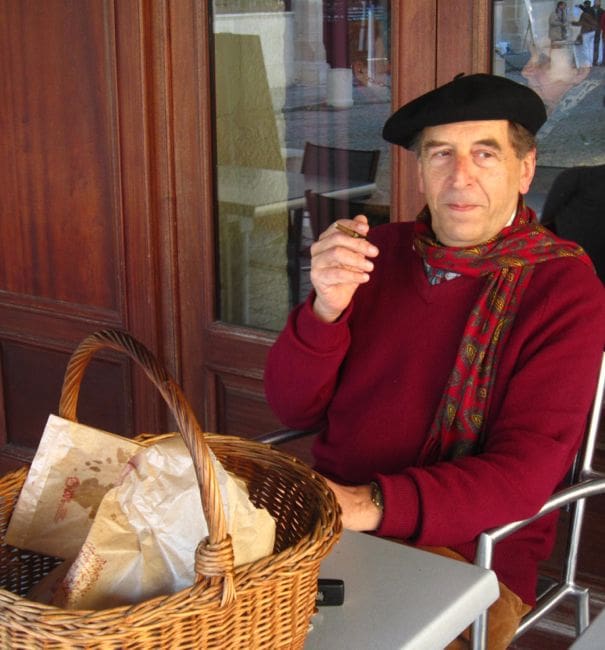
Photo: If you want to pass yourself off as French, get the beret, the scarf, the Gitane, the croissant, and get those common expressions right. My British friend Paul has really nailed it.
Friends, but what sort?
ami, amie: as you may have learned, this word means friend. And so It does, but a long-term or close friend. You don’t throw this word around lightly.
Instead, for a casual friend, use copain, copaine.
Note that petit ami or petite amie means a boyfriend or girlfriend. Beware: un copain is a friend, but mon copain is a boyfriend, ma copine is a girlfriend. As in a love interest.
Love Levels
Aimer is to love. Aimer bien is to like. Go figure!
Bienvenue Chez Nous!
In English we say “welcome” when someone shows up at our house. In France, it’s tricky, I’d be interested in hearing more thoughts on this. Nicole says this word may used to welcome someone to your house, but only if they’ve never been there before. After that, you must get creative: Je suis contente de te revoir, for example: I’m happy to see you again.
Proceed slowly
Students usally learn lentement for slowly.
That’s correct, but for most uses of this word, the French use doucement. Doucement means gently, softly, calmly, lightly. As in, Parlez doucement, s’il vous plâit!
It all starts with Hello:
Bonjour is always correct (except on the phone)
Less formal: Salut
Very familiar, with good friends or young children: Coucou
To answer the phone: allô (ah-low). This is just about the only time this word is used.
Getting the weather right
The French love to talk about the weather.
When it’s frickin’s freezing, they’ll invariably say, c’est pas chaud, (it’s not hot), accompanied by a French shrug.
You knowIl fait beau means it’s nice , sunny weather, but you should know these common weather expressions as well:
Il fait bon: it’s warm
il fait frais, it's cool-ish
Il fait lourd: it's oppressive or humid
Parting Words
Bon soir can be used early evening or after work. But it is more commonly used as a parting expression, at least in some regions. It more closely resembles our 'good night', though it starts earlier.
Bonne nuit mean sleep well.
And to all you French students out there: Bon courage!
In the COMMENTS: Ido, welcome back, we've missed you! Mark, Herm, and Catrina, loved the memoires the post broght up. Gregory, can't wait to see that car!















14 thoughts on “Some Common French Expressions You May Be Using Incorrectly”
Copain, Copine (etymologically: du même pain, from the same bread) just as compagnon which has the same latin origin but which means somebody you live with but without being legally married. Strangely enough a lady will speaks about her compagnon while a man will say ma copine.
Like you say, go figure!!
Love your blog and the way you look at those strange and funny people: the French…
Thanks for these explanations. I try to learn a new phrase or word in French every week in anticipation of my next trip to France but somehow nothing rolls off my tongue as it should. And I don’t believe I’ll ever be able to pronounce an “R” properly. Nor will I be able to say anything as quickly as the French do. I was telling a young Frenchman all the phrases I’d learned for my last trip to France and he said “I can tell you are from the South because you speak so slowly.” He had been to Virginia 4 times.
Thanks- needed the subtlety with between ami/amie and copain/copaine. Ohh so much to learn!
Bonjour Lynn and thank you for another great issue on France and Les Francais! This blog I should have had many years ago. Miss you comme d’hab!! Gros bises, M
Oui, comme Claude a dit, c’est “copine” et pas “copaine” mais c’est juste!
Thank you! Love the language posts on here.
Love this Lynn! I have one question though….is the only way to say “Nice to meet you?” Enchante? The English part of me feels that might not be as appropriate in a business setting as in a social setting. Does it matter?
Love your posts! Thank you!
Thanks, y’all, for the correction. So nice to have my own editors, merci!
Bonjour Lynn & thank you for this explanation. Quite interesting, and how I wish I could speak is fluently.
Here is Arizona, it is fait beau & this is why we live here. The best time of the year is here & more to come.
Thank you,Lynn,for this wonderful(and informative!) post!
I had a good laugh at myself,after previously congratulating myself for using some of these expressions and then discovering I’d instead made quite a few boo boo’s!(bon courage is an understatement!)
Missed participating in last week’s lovely post,my Kindle decided my remarks belonged out in cyberspace somewhere and then emailed them there.
Have a wonderful weekend!You certainly made ours just that! I
A just-in-time post, so my French will be better when I return to Aix Sunday – merci! I usually say Bonjour when responding to the door phone (when someone rings from the street on the intercom) – is that correct, or would Allo do there too?
I’ve noticed the use of bonne journee (with accent) when taking leave of someone during the day. What about bonne soiree (with accent) when taking leave of someone during the evening? (No idea why I can’t get my French keyboard to work tonight.)
Sometime ago,I posted a comment recommending an excellent book, “The Complete Merde” by Genevieve.
Amongst many other gems, it contains this useful piece of information. In French, a kiss is “un baiser” but the verb to kiss is “embrasser”. Unwitting English speakers sometimes use “baiser” as a verb, but used as such it means something much more intimate which I’m not prepared to explicitly explain on such a respectable blog as SFF! If you’re interested, the Larousse dictionary (available as an excellent app for iPad, iPhone, all Android devices and Windows 8 smartphones) will put you right.
Loved this post Lynn and just in time to help keep my French current as we spend the winter in AZ with family. Missing France already in many respects and enjoying some of the simple pleasures of life in the U.S. including some wonderful southwest food!
Best wishes to you and Ron for a wonderful Thanksgiving.
Thanks for the post. I knew copain, but not how it relates to ami. So now I understand that copain is more like “acquaintance” (although I think I’ve heard it used for someone who is more than an acquaintance). My favorite word in French is “doucement.” I hear it used in many contexts — a kind of all-purpose word for “chill” I guess. Often parents direct it at kids who are a tiny bit rambunctious in public. I’ve had it used for dogs. I’ve had it used to quiet someone. Mostly, though, I like the sound of it – a peaceful word.