
While in Charleston this winter, I was at a party when I spotted the well-known cookbook author Nathalie Dupree, and I headed right over to meet her. With her chic blond haircut and winning smile, the queen of southern cooking loves to talk food. Later I sat down for a cozy chat with this remarkable cook, to talk about her new book, Mastering The Art of Southern Vegetables
Nathalie is the perfect cook to invite to this blog: a southern girl who writes about southern cooking, but she’s also lived in Europe and trained at the Cordon Bleu. Her books are eminently approachable for the home cook.
She is the author of twelve cookbooks, including two James Beard Award winners: Nathalie Dupree's Southern Memories: Recipes and Reminiscences


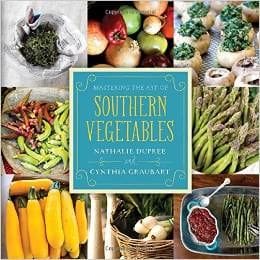 Why did you choose the topic of vegetables?
It really evolved from our larger book, Mastering the Art of Southern Cooking
We wanted to combine the old ways of cooking with the new ones, in ways that address the vegetables that are accessible, depending on your growing season.
Do you see a shift or change in the role of vegetables on the plate in this country?
Yes and no. A vegetable plate has always been standard fare at a diner, and the alternative is ‘meat and three vegetables’. But in the past those were cooked another way—maybe they’d been canned or jarred, or boiled. Asparagus, for example, was rarely grilled. Our cooking now is now more ‘of the minute’. There is much less water cooking now than there used to be.
Vegetable cooking is now more French in style. When I started my restaurant in 1971 in Social Circle, Georgia, and I cooked green beans that were tender-crisp (the French way) instead of being simmered long and slow, people were shocked.
How did you get started in cooking?
I started cooking after my sophomore year in college. I told my mother I wanted to be a cook, and she told me, “Ladies don’t cook”. This was 1959, and there were not many women in the field. Then I married and moved to London in 1969, and stumbled onto the Cordon Bleu cooking school in London. There I happened to meet Julia Child, at graduation. And I didn’t have to be a lady anymore.
What is your French connection?
I’ve been to France many times, and lived briefly in the Loire Valley. Like the French, the South has specific techniques for cooking, but we have learned from the French and have incorporated much of their love for fresh vegetables cooked in spritely ways. When you really look at it, the whole idea of the importance of the freshness of vegetables is very French. It dovetails well with where American cuisine is headed.
I notice you refer to yourself as a cook, instead of a chef.
‘Chef', a French word, translates to ‘chief’. I think of myself not as the chief but as the cook. It’s an attitude really. I’ve been a chef in a restaurant, but I still don’t think of myself as a chef. I don’t have that title to live up to.
Do you grow your own vegetables?
I grow whatever I can, but living in the Charleston historic district, with its formal gardens, means I only have a small plot of land. I may be the only house in Charleston to have collards and turnip greens growing in the front yard of my house.
 It’s interesting that you went out into the fields to research the book.
We started visiting the farms many years ago for my TV shows. Cynthia was my producer at the time. Even back in the 80’s we visited farms to see how the vegetables were grown. There’s nothing like picking a melon off the vine that’s ripe, where you can smell it and squeeze it. All of that matters when you’re writing about vegetables, so you can describe what a melon feels like and looks like when it ripens. Photo left: the authors out in the fields (from Flavors Magazine).
If you were inviting a bunch of carnivores over for a dinner party and wanted to serve them a vegetable dinner, what would you serve?
Well there are many vegetable main dishes—eggplant lasagne is an example—that would make good main dishes. I also like to serve grits and greens, and everyone loves them. But I also might serve a variety of vegetables. Put out a plate of potatoes roasted with sea salt and some grilled vegetables at a cocktail party, and the men will stand over them and eat them like they were shrimp.
Sometimes I’ll serve guests a meal featuring just one ingredient: like asparagus with soy sauce, asparagus with shrimp, asparagus for dessert dipped in chocolate. Everybody who gets invited to my house is a guinea pig. They expect something glamorous, but I experiment on them.
I love the fact that you encourage creativity when cooking. Any tips for home cooks who are terrified of tweaking a recipe?
You should do a recipe the way it’s written the very first time. Once you’ve mastered a recipe, you can be pretty fearless. Of all the ways of cooking, I find that cooking with vegetables is the most forgiving.
If you’re in Charleston, you might catch one of Nathalie’s cooking classes at Southern Seasons. She travels around the country doing cooking classes as well. You can find class schedules and recipes on her website and blog, such as this Roasted Tomato Tart, which is both southern and French.
Now, a question for you, dear readers: What irresistible veggie dish would YOU serve to a crowd of carnivores?
In the COMMENTS: It was fun this week to hear from Michele, who knows the Caffé de REL well; from Mark, who recommends a nearby native plant conference; and from Natalia, who has kicked our recipe up a notch! Vicky, we actually did go to the Scottish plaid museum, which was very unique.







5 thoughts on “Chatting with a Favorite Cookbook Author”
Try a butternut squash, walnut and blue cheese lasagne.
Lynn,I would make stuffed tomatoes(Bocuse style).
Not intimidating to prepare and can be reheated.
THANK you for this wonderful post!I have thoroughly enjoyed Nathalie’s
books and miss seeing her programs on TV
Love this interview with one of the “greats”……vegetables to carnivores? Garlic roasted cherry tomatoes on baguettes and a huge mixed baby lettuce salad with loads of different grilled vegetables..and CHEESE (I know that’s not a veggie 🙂 ).
I’ve actually tried that roasted tomato tart but I found it somewhere else. It’s wonderfully delicious! I must take a longer look at Nathalie & her recipes. Thank you for this gem!
I am reading this a bit late as it is now Jan. 2016!!!!
Was this at my Lovely Ladies Party that you met her? I just had her over for
Moroccan food and wish I had thought to invite you!
Dani