
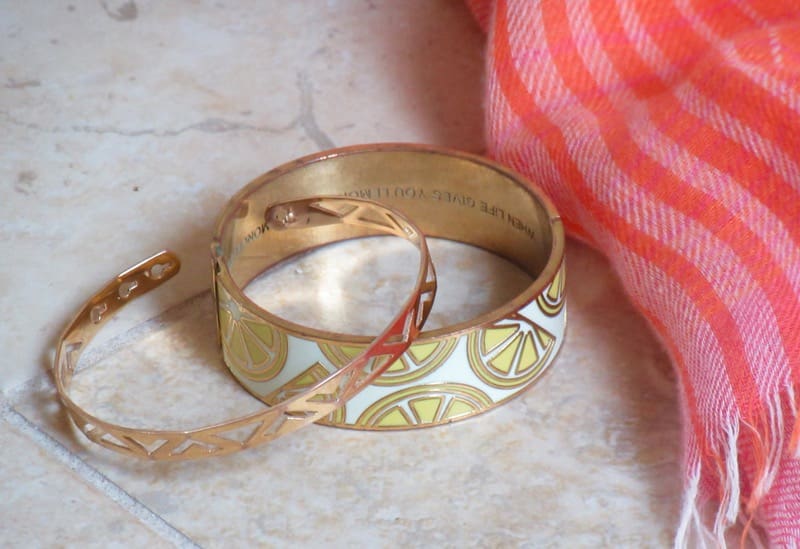
 My step-daughter Suzanne gave me a darling bracelet for my birthday one year, which is still my favorite. The outside is tossed with bright lemon slices, and inside it's engraved to say: “When life gives you lemons, make limoncello”.
Wise words indeed. Though it’s an Italian tradition to offer ice cold limoncello as a digestif after a fine dinner, some of our friends here in France do it too, as do some restaurants (a digestif, by the way, taken after a meal, is a little nip of liquor to settle the stomach. May I suggest we all might be needing that in the coming months, in order to face the daily election news?).
You may be shocked to learn how easy it is to make limoncello yourself, and what a nice surprise to offer after a meal with friends. But it’s one of those either/or things: folks either adore the sweet, citrusy taste, or turn up their noses at the sharp sugariness of it.
I’m afraid I’m in the latter camp. Our friends Gerard and Maria, who are Dutch, make their own, and I politely decline (though limoncello lovers tell me theirs is fabulous). But one night they brought out another homemade bottle: orangecello! And to my surprise, I loved it. By the way, anglophones will call it orangecello, but it is properly called arancello, after the Italian word for orange, arancia.
Gerard and Maria have kindly shared BOTH of their recipes. In Burgundy liquors are often made with Marc de Bourgogne as the base, but you can use a clear, neutral high proof alcohol like vodka (as they do), Everclear, or grain alcohol.
Both recipes are below. Which one will you choose? Or maybe both? Salut!
 RECIPE: Gerard & Maria's Limoncello
For 1 liter:
Put the thin yellow peel, only the yellow part and not the white, of 4 organic
lemons in one litre (4.5 cups) of vodka for at least 10 days.
Strain the mixture and remove the peels after 10 days or more.
Add 270 (1 1/4 cups) to 300 (1 1/2 cups) grams of sugar as desired
Shake until the sugar is completely dissolved
Keep the limoncello in the freezer.
RECIPE: Classic Aranacello
For 2.5 liters:
5 large oranges, preferably organic
1 stick of cinnamon
3 cardamon pods
1 vanilla bean (do not split it)
1 liter of vodka (4 1/2 cups)
50 cl water (2 cups)
600 grams sugar (3 cups)
Peel a thin layer of orange zest from the oranges with the help of a vegetable peeler. Remove only the orange part, avoid the white inner layer, which is bitter.
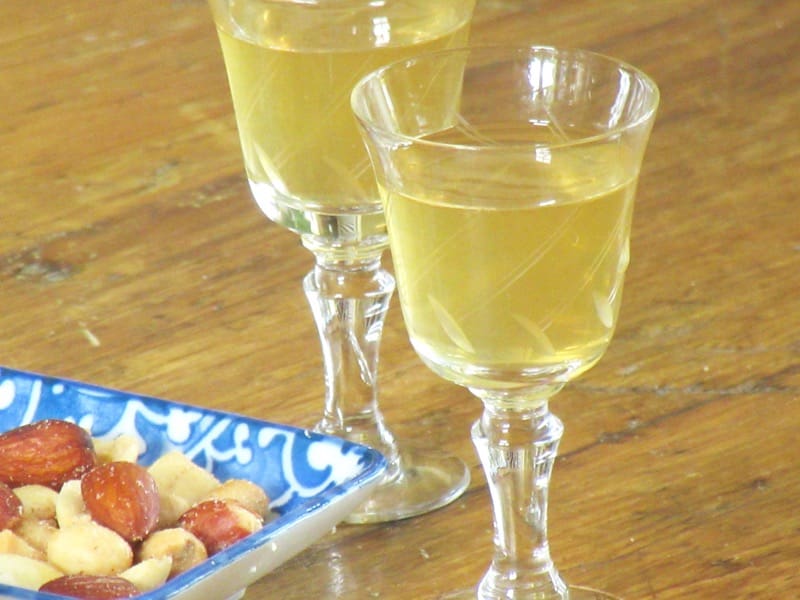 In a large jar, place the orange zest, the cinnamon stick, the vanilla bean, and the cardamon pods. Add the vodka and close the lid. Shake well. Leave it for a week, shaking every day.
After 1 week: Bring the water to a boil, turn heat off and add the sugar, stirring until it dissolves. Cool slightly. Add it to the vodka mixture and let it sit another week, shaking the jar regularly.
At the end of the week, filter the aranchello, transfer it to a bottle, and keep it chilled. Garnish with more orange peel if you like. It will last for 6 months.
Photo below: Gerard and Maria, thanks for the recipes!
 In the COMMENTS: We've been talking about Champagne this week. The photo with the tractor and the flowers? That's the orangerie of the Trianon of Moët & Chandon, and our own loyal reader Michaela Rodeno has stayed there. And she wrote a book about champagne!– see below (along with recommendations from Rainey). Anne Marie has a B&B to recommend in Champagne. Suzanne, Champagne IS expensive, and here in Burgundy we drink the local version, called crémant, which is way cheaper, and delicious. Not sure if you can get it in the states. Beth, I'm so happy you're still enjoying the classic Spanish gazpacho recipe. I make it every week when the local tomatoes arrive.
Favorite Reads: Michaela Rodeno spent a career in the wine and Champagne industry, and From Bubbles to Boardrooms, Act 1 and Act II














8 thoughts on “When Life Gives you “les Citrons”…”
I love making a crema di limoncello from a recipe passed on to me from my Italian Mother-in-laws equally Italian friend. The crema part is milk and sometimes I used oranges as well. The flavor reminds me of the old 50/50 ice cream bars of my youth. I use meyer lemons or California navels, both from our trees.
I am very fond of limoncello. I’ve never quite found anything as good as that first sip on the Amalfi Coast. I recently received a recipe from a friend. I’m waiting for my lemons to ripen before trying. I think I’ll just try both these recipes to compare. Thanks, Lynn. You never disappoint.
I’m with you on any distraction from the election coverage–despite the fact that I’m often riveted to the t.v. screen. Will it ever be over???
And I’ve been following all the talk about the French election as well. The run-up is just as long–but different.
Domaine Chandon is the offspring of Champagne Moët & Chandon, which is what gave me license to visit la champagne from time to time on business. There’s nothing better than an all-champagne meal, elegantly served up in 18th century gilded glamor. Those adventures and more form Part I of Bubbles to Boardrooms, which is now consolidated with Part II (about St. Supery, another major startup in Napa Valley, board service, and our tiny family winery Villa Ragazzi). Thanks for the mention, Lynn!
Dear Lynn,
Your bracelet is gorgeous(!)
And even more,who gifted it to you!
Such love and blessings!
I confess that I’ve never been a fan of limoncello(younger days partial to Gascony’s gift) but this recipe(s)(!)makes me want to totally reconsider.
God help us for the election(s).
WONDERFUL reads!
I had a glass of Limoncello when I was in Italy, however, I think it’s an acquired taste. With all the lemons we have here as well as oranges, tangelos, etc, I will indeed try your recipe of Aranacello. Now this sounds right down my alley. Thank you for the recipes Lynn, beautiful post Lynn.
What fun these recipes will be to make for Christmas gifts. Thanks for all the fun things
you share!
Lovely post as always Lynn. I too recall my first limoncello on the Amalfi coast of Italy, in beautiful Ravello. A little family run restaurant where the proprietor and cook walked around to all of the tables offering this delightful drink after our dinner. How wonderful of you to share these two fabulous recipes. Merci et bon Dimanche.
I’m a little late to the post. However, could you clarify one part of these recipes for me. When you’re waiting a week or so for these liquids to steep and shaking the jars regularly, do you have to keep it in the refrigerator or can it be left on the counter? I understand when finished we would store in the freezer, but what about during the process of making it?