
When expats buy houses in the Burgundy, they often have a wish list (we did!). An old stone house. Charming of course! With a pigeonnier ( a little tower). A boulangerie in the village. Fabulous views, bien sûr! A galerie macconaise across the front. A southern orientation. And so it goes.
Of course, many things get deleted quickly, as reality checks in. There are't many houses for sale, and the charming ones always seem to be happily occupied.
On everyone's list, though maybe just as a wouldn't-it-be-wonderful-to-have item, is the ultimate country French accessory: a four à pain. A four à pain is an old bread oven, where fires were once stoked and baguettes baked amongst the embers. Those that still exist are often now pressed into service to make wonderful pizzas.
I've shot houses for our magazines in the States that had them in their trendy kitchens. Here in France, they hark back to medieval times, when they were not just a designer accessory, but the way bread was made.
The French used to bake their bread on the hearth, but in the Middle Ages community bread ovens, some inside of a small bakehouse, began to pop up. Residents would take their own dough to the bread oven to be baked. The wood-burning ovens, fashioned from brick and stone, were deep and vaulted, and might take hours or days to heat up to the proper temperature. Bread was scooted in and out of the deep ovens with a long handled peel. A large house might even have their own oven; we looked at several houses for sale that had them, free-standing or tucked into a barn. These days, village or residential bread ovens are often pressed into service for a fête, to bake up something festive.
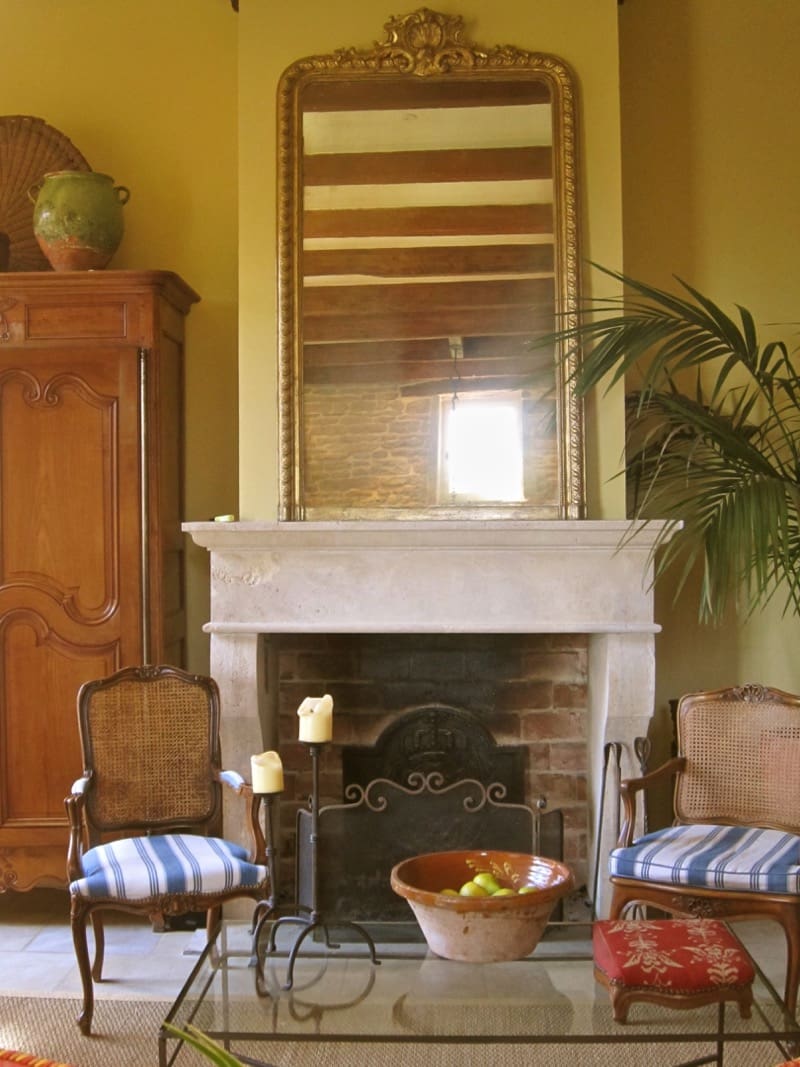
Speaking of shooting houses, I once shot a house in Charleston owned by a French expat. She had a standard fireplace with a bit of a raised hearth in her den, and she liked to cook "on the hearth", just like folks used to do. She used it like a grill; she had a simple standing raised rack she put over the embers, and she cooked roasts, steaks, chicken, everything, the old fashioned way. Good idea? I haven't tried it, but why not? A rack, a few bricks to support it, and you're in business! (photo above : the fireplace chez nous–big enough for a nice roast, you think?).
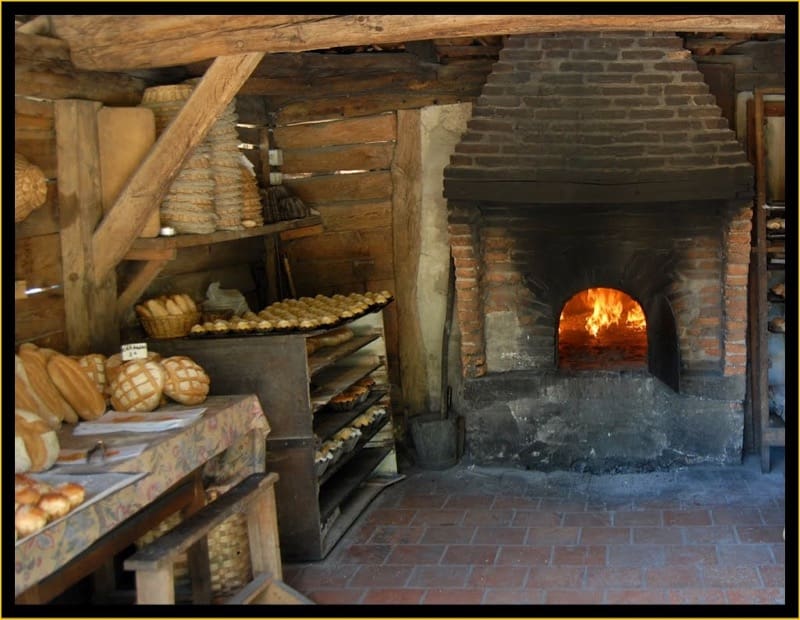
Photos: at top and below, a restored village four à pain in our area, being used to make pizzas at a fête.

The photo below, courtesy of Panoramia, shows an ancient four à pain, still in use
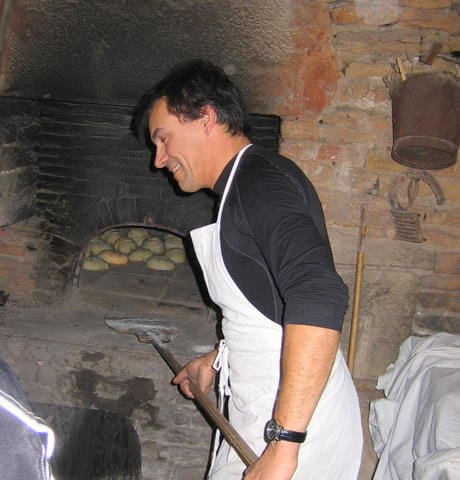
There is a communal bakehouse in Balleure (our château village), and when the baker goes on vacation, the villagers turn out to make bread themselves, the medieval way. This is Frédéric, an accidental Balleure baker. You can read about it at this post from 2010.
In the COMMENTS: Natalia has some books for us, see below, and some tips for our pastry, as does Suzanne. Colleen, thanks for solving the mystery of my wooden kitchen tool! Tom, congratulations on the house and the big move, please keep us posted. Chrisophe, can't believe you found a croissant cutter in Portland! And, I'm not surprised we have a lot of flea market shoppers in the group. Mindy, you can find the recipe for the olive oil toasts here. Glad you brought them up, Connie, I haven't made them in a while.
Favorite READS: I always love the books our loyal reader Natalia recommends. She has two for us this week, which I can't wait to dip into: The Tuscan Child by Rhys Bowen, and The Lost Vintage, by Ann Mah, which is set in Burgundy. Suzanne, thanks for alerting us to Martin Walkers new Bruno book, A Taste for Vengeance. I'm halfway through the series and I don't want it to end!






8 thoughts on “A New, Very French Use for Your Fireplace”
Big Green Egg users know how good bread is that’s cooked on an egg. They’re ceramic and you cook everything with the top closed, and with a pizza stone on the grill they’re just like those old brick and stone ovens. Only real difference is that Eggs use charcoal, so the flavor is just a tad different from wood.
The women of the village used to cook their Sunday roast in the village four a pain after the bread had been baked.
Thanks for directing me to the link to the recipe! I am going to try making them this weekend.
Thanks also for the book suggestions. As it happens, I just finished The Lost Vintage, and I enjoyed the story while gaining a new appreciation for the art of wine making. I’m not familiar with Martin Walker, so I’ll add him to my “authors to explore” list, and I’ll definitely look into The Tuscan Child as well.
Although I’m a die-hard-hold-a-book-in-my-hands reader, Kindle has this whispersync feature where you can read and listen to a book at the same time. I find that certain authors need to be heard as well as read, and Fannie Flagg is such an author for me. I’m currently reading and listening to The All-Girl Filling Station’s Last Reunion. So far I’m loving it.
We accidentally happened upon the fete du pain on a Sunday in Cours Les Barres(sp?) on the Loire canal. The men of the village were baking many loaves all day. The two of us ate a whole loaf with probably a half pound of butter, and went back for another! We were impressed that it was also election day and a market for many things. Later that afternoon the ladies of the village were selling a wonderful meal including more bread. It was our favorite stop. of many canal trips
What a surprise to hear about Martin Walker’s latest book. I generally stay on top of this series and order ahead of publication. And I’d love to read another of Ann Mah’s Books. I’m in the middle of Marcel Pagnol’s La Femme du Boulanger. Years old and not his most famous, but most entertaining and a short read. And I hardly need my dictionary, which is most satisfying. I mention it because you said you had been looking for a village with a boulangerie. Wise choice.
How I enjoy your posts, Lynn.
Years ago I spent 3 weeks in a small village deep in the Cantal, ancestral home of the father of a friend. I was fortunate to be there for the fête du pain, an annual celebration. The men of the village were the bread makers. Large round loaves were made in the morning and put in baskets kept in a barn until time for the oven – the traditional village bread oven. The men set up long boards for tables for the communal feast. After a great meal, including
aliot (wrong spelling I’m sure of a scrumptious potato/cheese dish) they set up a raised , boxing-ring type structure 5’ off the ground, with wooden floorboards where everyone danced to the music of an accordion and snare drum. What a great experience!
Lynn,today’s post really captured my imagination.And made my mouth water!Both sets of grandparents from my belle mere and belle pere’s sides baked in just this way.Their descriptions of what and how they prepared things was a wonderful slice of time.
I did try cooking “on the hearth”.When things turned out,they were really good,but(!)no doubt due to the operator’s(guess who )boo-boo’s,the less than successes made a major mess.
Thank you for mentioning me with these books.Hope you will enjoy them as much as I did!
Hi Lynn,
A fireplace brings so much joy and memories. And yes, my mom would say bread is best baked on the hearth 🙂
I would love to check on your favorite reads.
Thank you so much for sharing!
Cheers,
Jessica