In SO many ways, the French have taught us to change our habits. And in this day of high energy bills and climate change, the frugal practices they’ve used for years are looking pretty smart. We have gotten on board.
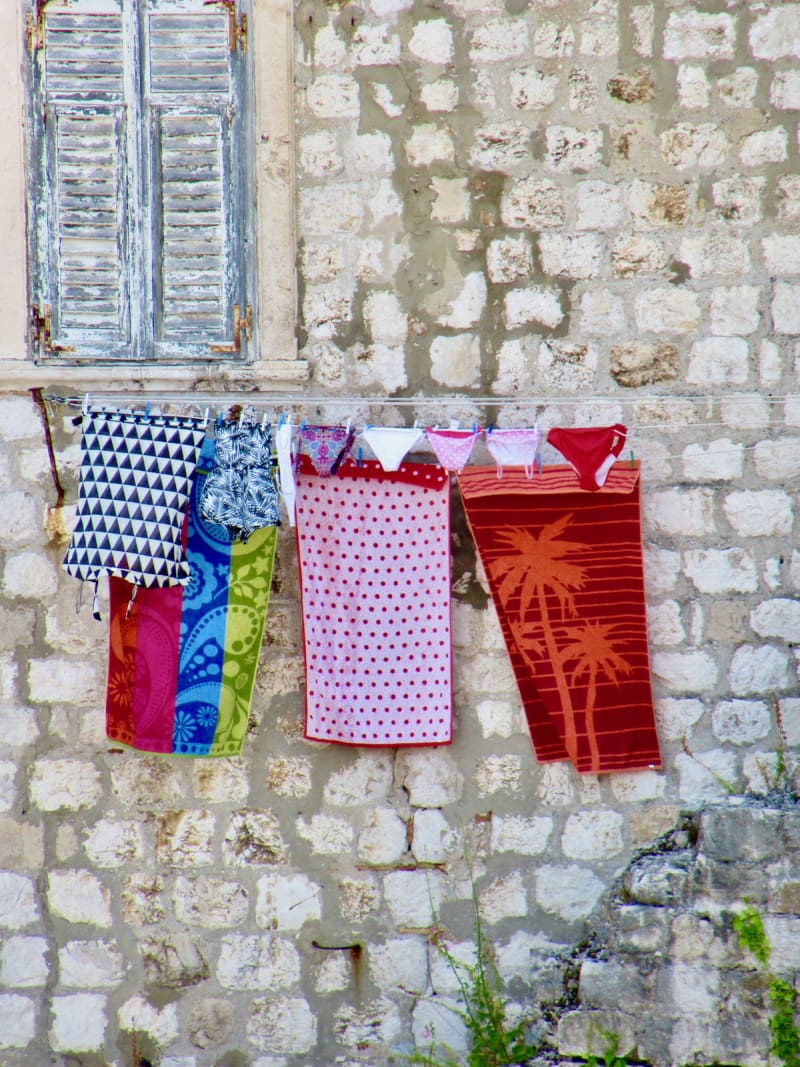
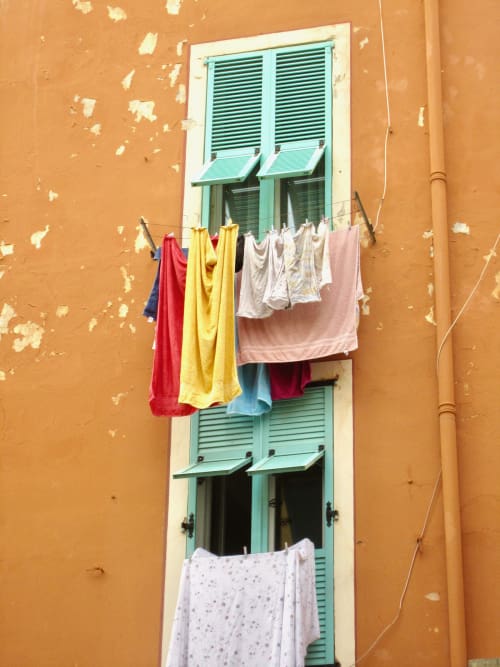
Let’s start with dryers. All that spinning and heating eat up a lot of energy. Most French folks don’t even have them, and if they do they use them sparingly. They hang their clothes outside, and not just for energy savings. They like the fresh air smell, and the sun helps to “blanchir” (whiten, brighten) things like sheets and towels (it’s better for your clothes, too).
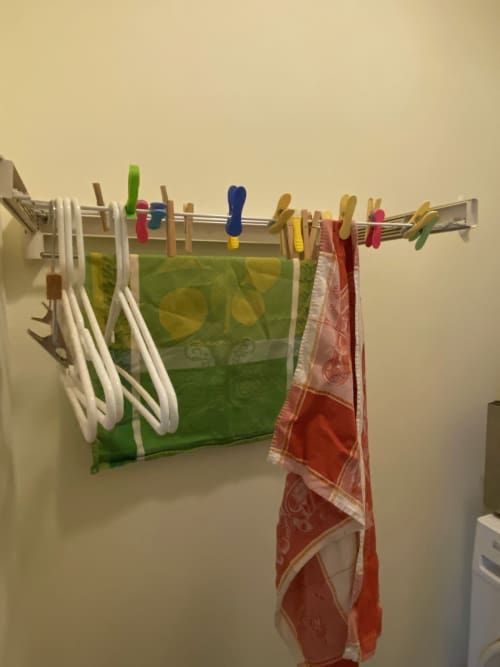
If clothes lines are banned in your neighborhood (an unthinkable thing in France), try an expanding wall rack. I manage to dry almost all of our clothes this way.

Then their is heating and cooling. The French use a passive solar approach. You may have noticed that almost all French houses have (fully operational) shutters. Houses have fewer windows here, and they rarely face north. When it’s hot, shutters are closed as the sun moves around the house, and opened back up as it moves along. It’s a bit of work, but it’s second nature for us now. Because it makes a HUGE difference. If your walls and floors never really heat up, the house stays cool. Everyone has standing floor fans, and the breeze they create is wonderful—much better than ceiling fans, I find. Despite a prolonged heat wave this year with temperatures often hitting 100 degrees, we very rarely turned on our AC system. The French in general are not fond of AC—it’s fresh air all the way for them. Je suis d'accord!
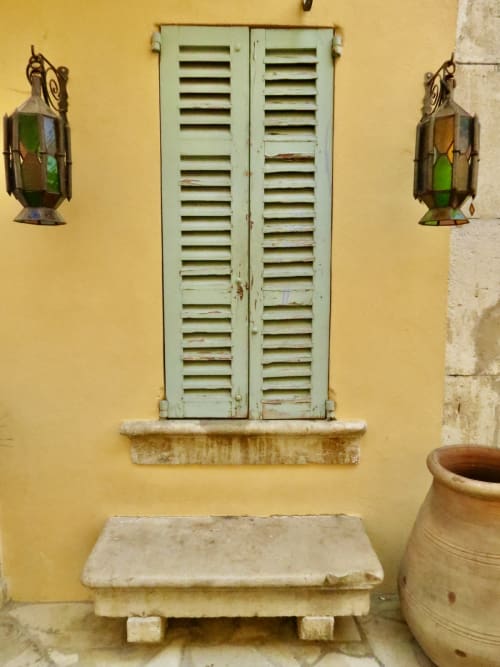
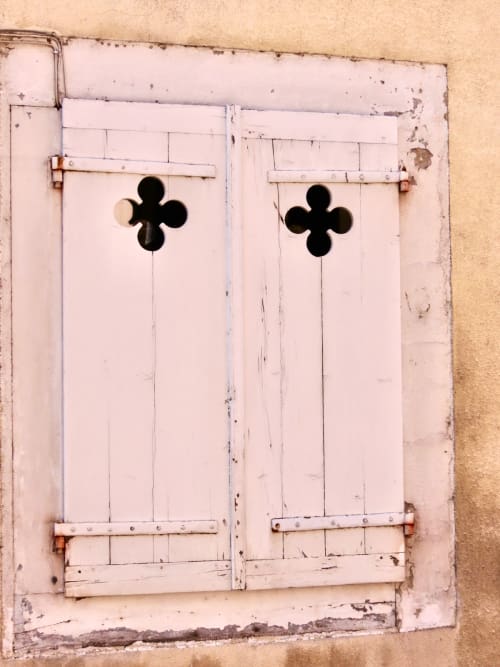
In cold weather, these same shutters are closed at night, to block out a bit of the cold.
American houses tend to have vast expanses of glass, and if they have shutters, they typically aren't functional or aren't used. Partly due to the fact that screens are usually necessary to keep out bugs, but we don’t need screens here. However, we did have screens on our bedrooms windows in our former French house (to keep the bats out at night!), but they were retractable, so we could still use the shutters. I don’t know why all screens in the States aren’t retractable, it’s such a clever thing. There is something wonderful about a window that swings wide open to the sky.

One more thing: the French will never turns several lamps on for ambient lighting (guilty as charged!). Only the ones they need, which are always switched off when not in use.

The French are by nature super frugal, and it’s serving them well in these troubled times. We could all be a little more French these days! Now what about y'all? Any energy saving tips for us?
Favorite READS: My friend Suzanne in Charleston, an avid reader, suggests a new French themed book for us: In Love with Paris, Recipes and Stories from the Most Romantic City in the World. Oh la la! Our voracious reader-in-residence Natalia recommends Lost in Translation by Ella Sanders for language lovers, and The House of Fortune by Jesse Burton, which she says is a "page-turner". And happy anniversary, Natalia!

















24 thoughts on “Saving the Planet, French Style”
You are amazing!
You are amazing!
You are amazing!
I am Canadian-Swiss and lived 10 years in Switzerland. Things are very similar there. Switzerland has decentralized industry meaning people can live close their workplace, avoiding long commutes. Because of that it is the custom for those who can to go home for their midday meal. The midday meal is the main meal of the day so there is a lot of electricity used between 11 and 2pm. For that reason it is impossible to use washers or dryers (the latter which hardly anyone has anyway) because electricity is actually shut off nationally to all washers between those high-use hours. Another example: it is not allowed to wash your car in the driveway, protecting the ground water from cleaning chemicals and avoiding overuse of water. Europeans in general are more aware of the value of natural resources than North Americans who have been spoiled with exceptional abundance.
I am Canadian-Swiss and lived 10 years in Switzerland. Things are very similar there. Switzerland has decentralized industry meaning people can live close their workplace, avoiding long commutes. Because of that it is the custom for those who can to go home for their midday meal. The midday meal is the main meal of the day so there is a lot of electricity used between 11 and 2pm. For that reason it is impossible to use washers or dryers (the latter which hardly anyone has anyway) because electricity is actually shut off nationally to all washers between those high-use hours. Another example: it is not allowed to wash your car in the driveway, protecting the ground water from cleaning chemicals and avoiding overuse of water. Europeans in general are more aware of the value of natural resources than North Americans who have been spoiled with exceptional abundance.
I am Canadian-Swiss and lived 10 years in Switzerland. Things are very similar there. Switzerland has decentralized industry meaning people can live close their workplace, avoiding long commutes. Because of that it is the custom for those who can to go home for their midday meal. The midday meal is the main meal of the day so there is a lot of electricity used between 11 and 2pm. For that reason it is impossible to use washers or dryers (the latter which hardly anyone has anyway) because electricity is actually shut off nationally to all washers between those high-use hours. Another example: it is not allowed to wash your car in the driveway, protecting the ground water from cleaning chemicals and avoiding overuse of water. Europeans in general are more aware of the value of natural resources than North Americans who have been spoiled with exceptional abundance.
Lynn,this is another of your very thought provoking posts,and now more than ever,it is really appreciated.
We do many of the same things to conserve,here in Nevada,especially energy and water related are tops–keeping drapes closed during peak heat times(I remember my belle mere and belle pere in Belgrade doing what we we used to call “the dance of the shutters”!),and needless to say,solar power is a blessing.Also only utilising machine related items when either full or off peak hours.There are too many other practices to try to list here ;all of this is second nature by now.
Lynn,this is another of your very thought provoking posts,and now more than ever,it is really appreciated.
We do many of the same things to conserve,here in Nevada,especially energy and water related are tops–keeping drapes closed during peak heat times(I remember my belle mere and belle pere in Belgrade doing what we we used to call “the dance of the shutters”!),and needless to say,solar power is a blessing.Also only utilising machine related items when either full or off peak hours.There are too many other practices to try to list here ;all of this is second nature by now.
Lynn,this is another of your very thought provoking posts,and now more than ever,it is really appreciated.
We do many of the same things to conserve,here in Nevada,especially energy and water related are tops–keeping drapes closed during peak heat times(I remember my belle mere and belle pere in Belgrade doing what we we used to call “the dance of the shutters”!),and needless to say,solar power is a blessing.Also only utilising machine related items when either full or off peak hours.There are too many other practices to try to list here ;all of this is second nature by now.
In line with this post and Debra Amrein-Boyes’ above comment, my energy and water conservation habits are rooted in what I learned while living with two Swiss families of modest means when, decades ago, I was a high school and later a college exchange student in French Switzerland. I remember how incredulous each of my Swiss families was when they realized how blithely wasteful I was. From grandmothers to small children, the members of each family gently but firmly taught me the conservation habits that were an integral part of their lives.
I returned to the U.S. with those habits, which have been second nature to me and served me and my family well throughout the many decades of my adult life. They have allowed us to steadily reduce our use of energy resources while living comfortably without air conditioning in the summers, with minimal heating in the winters, and with rare use of a dryer. Our electricity, natural gas and water usage is much lower than that of our neighbors. Walking or biking as well as living close to work and working from home has reduced our use of a car. Recycling, reusing and selective buying has allowed us to steadily reduce our consumption of goods, foodstuffs and plastic packaging. Soon, we will soon downsize to a property that will allow us to grow much more of the produce we eat. We have found that when they become instinctive, these evolving measures do not take a noticeable amount of time or effort, and they allow us, in small but ever-increasing ways, to contribute to the health of our earth. As such, we are part of an
ever-growing conservation culture in the U.S.
In line with this post and Debra Amrein-Boyes’ above comment, my energy and water conservation habits are rooted in what I learned while living with two Swiss families of modest means when, decades ago, I was a high school and later a college exchange student in French Switzerland. I remember how incredulous each of my Swiss families was when they realized how blithely wasteful I was. From grandmothers to small children, the members of each family gently but firmly taught me the conservation habits that were an integral part of their lives.
I returned to the U.S. with those habits, which have been second nature to me and served me and my family well throughout the many decades of my adult life. They have allowed us to steadily reduce our use of energy resources while living comfortably without air conditioning in the summers, with minimal heating in the winters, and with rare use of a dryer. Our electricity, natural gas and water usage is much lower than that of our neighbors. Walking or biking as well as living close to work and working from home has reduced our use of a car. Recycling, reusing and selective buying has allowed us to steadily reduce our consumption of goods, foodstuffs and plastic packaging. Soon, we will soon downsize to a property that will allow us to grow much more of the produce we eat. We have found that when they become instinctive, these evolving measures do not take a noticeable amount of time or effort, and they allow us, in small but ever-increasing ways, to contribute to the health of our earth. As such, we are part of an
ever-growing conservation culture in the U.S.
In line with this post and Debra Amrein-Boyes’ above comment, my energy and water conservation habits are rooted in what I learned while living with two Swiss families of modest means when, decades ago, I was a high school and later a college exchange student in French Switzerland. I remember how incredulous each of my Swiss families was when they realized how blithely wasteful I was. From grandmothers to small children, the members of each family gently but firmly taught me the conservation habits that were an integral part of their lives.
I returned to the U.S. with those habits, which have been second nature to me and served me and my family well throughout the many decades of my adult life. They have allowed us to steadily reduce our use of energy resources while living comfortably without air conditioning in the summers, with minimal heating in the winters, and with rare use of a dryer. Our electricity, natural gas and water usage is much lower than that of our neighbors. Walking or biking as well as living close to work and working from home has reduced our use of a car. Recycling, reusing and selective buying has allowed us to steadily reduce our consumption of goods, foodstuffs and plastic packaging. Soon, we will soon downsize to a property that will allow us to grow much more of the produce we eat. We have found that when they become instinctive, these evolving measures do not take a noticeable amount of time or effort, and they allow us, in small but ever-increasing ways, to contribute to the health of our earth. As such, we are part of an
ever-growing conservation culture in the U.S.
Love the pics and the tips are certainly timely! xoxo
Love the pics and the tips are certainly timely! xoxo
Love the pics and the tips are certainly timely! xoxo
We are lucky to have installed solar a couple years ago here in California. Si8nce we are fairly close to the ocean, we usually don’t get very hot. I’ve had negative bills for the last 5 months! They also have a thing in California which warns us of possible brown-outs or black-outs and asks us to cool the house before a specific time then turn it off for some many hours. So, far, I think that has worked very well for avoids catastrophic black-outs. That is unless you think this someone from my Next-door app,”I am American and I can run my AC just as much as I want…it is my right!” I couldn’t get that out of my mind for a very long time… Very sad.
Also, Lynn, do you remember when they announced that in France, you should not put old clothes in the trash but take them to the “Goodwill” kind of store there and they will sell what the can and then separate the kinds of fabric so that they can each be disposed of properly? I thought that was such a great idea! Yes, I was very impress3ed by the French ideas of saving.
We are lucky to have installed solar a couple years ago here in California. Si8nce we are fairly close to the ocean, we usually don’t get very hot. I’ve had negative bills for the last 5 months! They also have a thing in California which warns us of possible brown-outs or black-outs and asks us to cool the house before a specific time then turn it off for some many hours. So, far, I think that has worked very well for avoids catastrophic black-outs. That is unless you think this someone from my Next-door app,”I am American and I can run my AC just as much as I want…it is my right!” I couldn’t get that out of my mind for a very long time… Very sad.
Also, Lynn, do you remember when they announced that in France, you should not put old clothes in the trash but take them to the “Goodwill” kind of store there and they will sell what the can and then separate the kinds of fabric so that they can each be disposed of properly? I thought that was such a great idea! Yes, I was very impress3ed by the French ideas of saving.
We are lucky to have installed solar a couple years ago here in California. Si8nce we are fairly close to the ocean, we usually don’t get very hot. I’ve had negative bills for the last 5 months! They also have a thing in California which warns us of possible brown-outs or black-outs and asks us to cool the house before a specific time then turn it off for some many hours. So, far, I think that has worked very well for avoids catastrophic black-outs. That is unless you think this someone from my Next-door app,”I am American and I can run my AC just as much as I want…it is my right!” I couldn’t get that out of my mind for a very long time… Very sad.
Also, Lynn, do you remember when they announced that in France, you should not put old clothes in the trash but take them to the “Goodwill” kind of store there and they will sell what the can and then separate the kinds of fabric so that they can each be disposed of properly? I thought that was such a great idea! Yes, I was very impress3ed by the French ideas of saving.
I grew up with my family hanging their clothes outside. We can’t do this in our HOA neighborhood, even in the backyard. With our heat, I wouldn’t even think of attempting this. Great ideas though Lynn. Thank you for sharing this.
I grew up with my family hanging their clothes outside. We can’t do this in our HOA neighborhood, even in the backyard. With our heat, I wouldn’t even think of attempting this. Great ideas though Lynn. Thank you for sharing this.
I grew up with my family hanging their clothes outside. We can’t do this in our HOA neighborhood, even in the backyard. With our heat, I wouldn’t even think of attempting this. Great ideas though Lynn. Thank you for sharing this.
As a minimalist myself who furthers zero waste, I am learning the French way!
As a minimalist myself who furthers zero waste, I am learning the French way!
As a minimalist myself who furthers zero waste, I am learning the French way!