
In this blog, we’ve spent years delving into the French lifestyle, culture, and that real puzzle: the French psyche. Let’s venture carefully into that last one, this week.
The French definitely have a reputation. Quirky, stubborn, elegant, frugal, reserved, unique, even rude or arrogant.

But what are the French really like, and how did they get that way? To figure that out, there is no better source than that great American writer, Edith Wharton, who was a keen observer of the French. She moved to France mid-life, wrote most of her novels there, and loves France because in France, “love merges with the ‘poetry of life’. ” Sitting in my powder room I have her book, called French Ways and Their Meanings. I dip into it from time to time, and I when I read her descriptions of the French, I always find myself saying, “Yes, that’s it! She nailed it!”. Actually, she has some pretty sharp observations about Americans too.
So for today’s post, I’ve lifted and organized some of her best quotes for you below. This post is longer than usual, but she has lots to say. (Note that when she says “we” or “our”, she is referring to Americans).

“French habits and manners have their roots in a civilization so profoundly, unlike ours – – so much older, richer, more elaborate, and firmly crystallized – – that French customs necessarily differ from ours more than do those more primitive races. We must dig down to the deep faith and principle from which each country draws from during life.”

“France had to fight for her existence ever since she has had any. Of her, more than of any other great modern nation, it may be said that from the start she has had, as Goethe put it, to “reconquer each day the liberty won the day before”. She has seen her territory invaded, her monuments destroyed, her institutions shattered.”

“Try to picture life under such continual minutes of death, and see how in an industrious, intelligent, and beauty loving people it must inevitably produce too strong passions: highest love of every yard of the soil and every stone of the houses. Intense dread, less than internal innovation, should weaken the social structure and open a door to the enemy. The price of nearly 2000 years of history and art and industry and social and political life to “conserve”; that is another of the reasons why their intense intellectual curiosity, their perpetual desire for the new thing, is counteracted by a clinging to rules and precedence that have often become meaningless.”

“For over 1000 years, France had to maintain herself in the teeth of an aggressive Europe, and to do so she has required a strong central government and a sense of social discipline.”
“The instinct to preserve that which has been slow and difficult in the making, that into which the long associations of the past are woven, is a constant element of progress.”
“We are a new people, a pioneer people, a people destined by fate to break up new continents and experiment in new social conditions, and therefore it may be useful to see what part is played in the life of a nation by some of the very qualities we’ve had the least time to acquire.”
“America, because of her origins, tends to irreverence, impatience, to all sorts of rash and contemptuous shortcuts; France, for the same reason, to routine, precedent, tradition, the beaten path.”

“There is a reflex of negation, of rejection, at the very root of the French character: an instinct to recoil from the new, the untasted, the untested. No one can hope to understand the French without bearing in mind that this unquestioning respect for rules of which the meaning is forgotten, access a perpetual necessary, a check to the idol-breaking instinct of the freeest minds in the world.”

“Intellectual honesty, the courage to look at things as they are, is the first test of mental maturity. Until a society ceases to be afraid of the truth in the domain of ideas, it is in leading-strings, morally and mentally. The singular superiority of the French is always laying in their intellectual courage.”
On lifestyle and culture:
“The very significant – – the note of ridicule and slight contempt – – which attaches to the word “culture” in America, would be quite intelligible to the French of any class. It is inconceivable to them that anyone should consider it superfluous.”

“The French, living more slowly, have learned the advantage of living more deeply.”
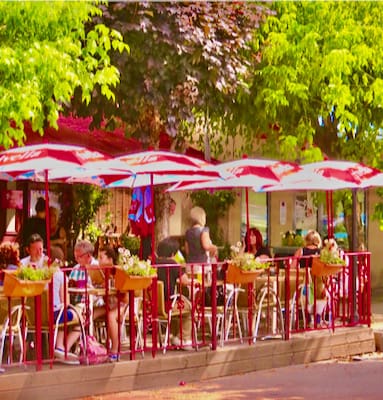
“Compared with other people, the distinguishing mark of the French person of all classes as a determination to defend their own leisure, and taste for the free play of ideas, and the power to express exchange of ideas on questions of great interest.”
On money, and the work ethic:
“The average French business person at the end of their life may not have made as much money as the American; but meanwhile, they have had, every day something the American has not had: Time. Time, in the middle of the day, to sit down to an excellent luncheon, to eat it quietly with their family, to read the paper thereafter; time to go off on Sundays and holidays on long, pleasant country rambles; time almost any day to feel fresh and free enough for an evening at the theater, after a dinner as good and leisurely as their luncheon.”

“Every French person takes time to live, and has an extraordinarily clear and sound sense of what constitutes real living.”
“The French are passion and pleasure loving; but they are above all acetic and laborious. And it is only out of a union of these supposedly contradictory qualities that so fine a thing as a French temperament could come.”
On their “ritual view of politeness”:

“The French are not courteous from any vague sense of goodwill toward mankind; they regard politeness as a coin with which certain things are obtainable and being notably thrifty they are cautious about spending it on strangers. They are bewildered by the Americans excess of ceremony on some occasions, and they’re startling familiarity on others. At any rate, in the older race, there is a tradition of trained and cultivated politeness, that flowers, at its best, into a simplicity democratic in the finest sense. Compared to it, American politeness is have to be rather stagy, as our ease is at terms a little boorish.”
Not all of her descriptions are positive:
“The French are kind in the sense of not being cruel, but they are not kindly, in the sense of diffused to benevolence which the word implies to Anglo-Saxon. They are passionate and calculating, and simple uncalculated kindliness – – the vague effusion of goodwill toward unknown fellow beings – – does not enter into a plan of life, which is as settled, ruled off and barricaded as their carefully measured and bounded acres.”
The French are not generous, and they are not trustful. But deep in their bones is something that was called “the point of honor” when there was an aristocracy to exclusive claim to it, but that has, reality, always permeated the whole fabric of the French people.”
And her last word on the subject:
“The best answer to every criticism of French weakness or French shortcoming is the conclusive one: look at the results! Read her history, study her art, follow up the current of her ideas; then look about you, and you will see that the whole world is full of her spilt glory.”

So, do you think Edith Wharton has been fair in describing the enigmatic French? I’d love to hear your thoughts! And many thanks to my friend Sandi, for gifting me this fun book.
















2 thoughts on “A Deep Dive into the French Psyche”
Dear Lynn,thank you so much for this! It is wonderful!
Have always been a fan of Edith Wharton,and you chose some of her outstanding thoughts and quotes!
Thank you for reminding me to read this book. I know it will be a good – great read. Any help with French psyche is always appreciated. So far many of my findings have been made over a “petit blanc” on a Sunday morning. Time….. Happy Spring!!