OK, francophiles and francophone wannabes, have I got a great blog post for you! We have a guest blogger today who teaches French on-line at Feel Good French—not just how to speak it but how to have fun with it, build confidence, and even make it into a social activity. I absolutely love her positive attitude! Deborah is une polyglotte, raised in the South of France, who has traveled the world and speaks a number of languages. I’m going to follow some of her wonderful suggestions, and I’m sure you will want to as well!

“So, you’ve packed up your life, moved to France, and now you’re happily retired in Aix-en-Provence, or maybe Beaune, or even a stone village somewhere with more vines than neighbors. Congratulations! You’ve landed in la belle vie.
But then comes the tricky part: French. That formidable language with its nasal vowels, vanishing consonants, and endless verb conjugations. Many expats sigh and say, “At my age? Impossible.”
Not so, says Lynn McBride, who quite literally wrote the book on it: How to Learn a Language with a Used Brain. Her witty, encouraging guide is proof that it’s never too late to take on French (or any language) and actually enjoy it.
(And thank you, Lynn, for hosting me here on your blog — it’s such a pleasure to share a few tips with your readers.)
You don’t need to speak like a Parisian professor to feel at home. You just need the right approach — one that favors joy, curiosity, and daily connection. Here are seven ways to get there.
Banish Perfection, Embrace Connection
If you’ve retired to France, chances are you were very good at what you did back home. You may have been the expert, the one people came to for answers. And now, suddenly, you’re fumbling for words a child could say. It’s humbling — but it’s also an invitation to begin again.
The French are not waiting for you to recite Proust. They’re waiting for you to say bonjour and maybe order your baguette without freezing. If you stumble? They’ll usually find it charming.
A few tricks to lighten the pressure:
- Celebrate small wins (one new phrase at the market). Bravo!
- Swap self-criticism for curiosity: “What can I discover today?”
- Visualize the smile you’ll get, not the mistake you might make.
- Listen to this meditation I created for you to gain confidence while speaking.
Perfectionism is the quickest road to silence. Connection is the road to belonging. Choose the latter, and your confidence will grow naturally. Petit à petit.
Make Immersion Your Daily Routine
Forget language labs and grammar drills. Your immersion is outside your door.
The marché in Aix or in your town is your personal classroom. If you go mid-morning, when the crowds have thinned, the same marchand will happily chat about whether his strawberries are sweeter than his neighbor’s. And voilà — You have had a French lesson disguised as shopping.
The trick? Go to the same vendors, at the same stalls. Build relationships. Repeat phrases. Watch your vocabulary grow like “courgettes” in July.
If markets aren’t your thing, try French radio (France Inter) or RFI (https://www.rfi.fr/en/), Netflix series like Dix pour cent, or Lupin, or even neighborhood signs. Life in France is a full-time immersion course if you let it be.
Arm Yourself With a Notebook
A secret weapon for retirees learning French: the humble notebook.
Before heading out, scribble down a few key phrases. Going to the pharmacy? Try:
- J’ai besoin de… (I need…)
- Avez-vous quelque chose pour… ? (Do you have something for…?)
Later, add new words you picked up. Over time, you’ll have a little book of survival French that’s more useful than any app. And unlike Duolingo, your notebook won’t scold you if you miss a day.
Put Pleasure at the Heart of Learning
If grammar tables make your eyes glaze over, skip them. French doesn’t have to be punishment — it can slip into the things you already love.
Do you cook? Follow a French recipe on YouTube and pick up the kitchen verbs along the way (éplucher, hacher, mijoter). Love music? Learn a single line of a chanson and hum it on your walk. If you’re a film buff, watch a French movie with subtitles and jot down just three phrases you recognize.
And it doesn’t stop there:
- If you golf, learn the French words for your clubs and chat with your partners about the parcours.
- If you do yoga, try a French YouTube class — you’ll learn inspirer and expirer without even noticing.
- If you enjoy wine tasting, listen to a French sommelier describe a bottle — soon fruité and corsé will roll off your tongue.
The secret is simple: if you enjoy it, you’ll keep going. And in language learning, consistency always beats intensity.
Challenge Yourself Daily (But Keep It Small)
You don’t need to spend hours with flashcards. Instead, set tiny dares for yourself:
- Ask your neighbor, “Ça va aujourd’hui ?”
- Try a new phrase at the market: “Vos tomates ont l’air délicieuses.”
- Memorize one sentence from a film and slip it into conversation.
- Practice real life dialogues like the ones I created “chez le docteur” ou “sur la promenade des anglais à Nice”.
Little challenges keep your brain nimble. And you’ll find yourself progressing without realizing it.
Learn the Art of Bavardage (Small Talk)
One of the quickest ways to feel at home in France is to master bavardage — the little asides and pleasantries that oil the wheels of daily life. It’s not deep conversation, but a smile, a comment on the weather, or a shared observation. These small moments create connection.
Here are some easy starters you can try:
At the market
- Quel beau choix de tomates aujourd’hui ! — What a beautiful selection of tomatoes today!
- Elles sentent l’été, vos fraises. — Your strawberries smell like summer.
With neighbors
- Vous habitez ici depuis longtemps ? (Have you lived here long?)
- Si vous avez besoin d’aide, n’hésitez pas. (If you ever need help, don’t hesitate.)
- Quel temps agréable, ça change de la semaine dernière. — Lovely weather, quite a change from last week.
- Votre jardin est superbe en ce moment. — Your garden looks wonderful right now.
In a café or boulangerie
- Il y a toujours du monde ici, c’est bon signe. — It’s always busy here, that’s a good sign.
- Le croissant est encore chaud ? — Is the croissant still warm?
- C’est animé aujourd’hui, non ? (It’s lively today, isn’t it?)
These phrases may seem simple, but they’re pure gold. A little bavardage shows you’re open, approachable, and willing to join in the rhythm of French daily life. Very often, you’ll find people answer back with warmth — and sometimes with a story you didn’t expect.
Find Your Tribe (and Start Talking, Not Just Studying)
Learning a language can feel lonely — unless you do it with others. Having a community of fellow learners makes all the difference: encouragement when you stumble, a cheer when you succeed, and a reminder that you’re not alone in the adventure.
That’s why I created the Feel Good French WhatsApp Club, a program starting this October that’s designed especially for expats in France. It’s not about memorizing endless grammar tables — it’s about getting your mouth moving and connecting with people.
Here’s how it works:
- Quick audio challenges – 2–3 per week, straight to WhatsApp. Five minutes, and you’ve practiced real French you’ll actually use.
- Practical themes – Ordering at the market, chatting at the café, booking a train ticket, greeting your neighbor. The kind of French that makes daily life smoother.
- Focus on pronunciation – You’ll train your ear and your mouth, so French people actually understand you the first time.
- The Apéro Club – Once a month, we gather online (wine optional, good humor required) for a relaxed meetup with fellow expats. Share stories, swap tips, laugh at mistakes — and feel less alone in the journey.
It’s simple, social, and flexible. No Zoom fatigue, no heavy textbooks — just a little spark of French that fits into your day and helps you feel more at home.
If that sounds like what you need, I’d love to welcome you. You can find all the details here: Feel Good French WhatsApp Club
Because yes, you’ll make mistakes. But it’s a lot more fun — and a lot more effective — when you make them together.
Final Thought
If this is your first time learning a foreign language, take it as a gift — a window into French culture and a ticket to real connection with your neighbors. Forget perfection, cultivate curiosity, and keep joy at the center.
Before you know it, you’ll be chatting at the market, trading recipes with your neighbor, or even cracking a joke in French. And isn’t that the real dream of retiring in France?
About the Author and Teacher

I’m Déborah. I grew up in the south of France, in a small village on the Atlantic Ocean. At home, my grandfather spoke Vietnamese, my grandmother Malagasy. Quite the mix! With family roots spread across four continents, my fascination for travel, languages, and cultures was inevitable.
At 17, I was in Togo building a library. At 22, guiding meditation in a Tibetan Buddhist center. At 23, backpacking through India and Nepal with no return ticket. At 27, teaching in China and receiving a prize for excellence from the University of Nanjing. A few years later, I followed my Kiwi partner to New Zealand — where French baguettes met Manuka honey.
Wherever I landed — Brussels, Lisbon, Valencia, Madrid, Wellington — teaching French was always the thread. I earned a Master’s in French as a Foreign Language, and I discovered that teaching isn’t about drilling grammar. It’s about adventure, curiosity, and connection.
That’s why I created Feel Good French: not just lessons, but coaching. My goal is to help retirees and expats in France feel at home. To dare to chat with their neighbor. To order with confidence at the market. And above all, to find joy (and even laughter) in their French journey.
In short: I’ve got your back.”
| And here is what a lesson might look like: |

Mille merci, Deborah. You’ve definitely inspired me to up my French learning game! Now don’t be a chicken–join the WhatsApp group, get out there and start speaking!

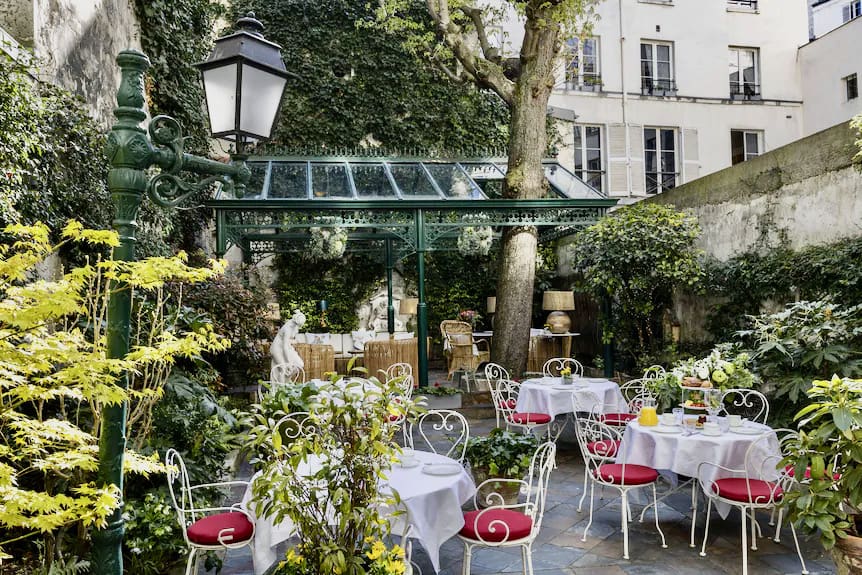
In the COMMENTS: Elizabeth, in Paris we stayed at Hotel les Marronnier, in the 6eme. The rooms are small and nothing special, but it has a pretty hidden courtyard in the back where you can hang out, get a coffee or a drink (pictured below). a fabulous location, for walking to Notre Dame or to St. Germain. Natalia, we are so glad you are wrapping up that treatment. Chris, I hope you make it back to Notre Dame. Tom (another expat in France), so good to hear from you! Francine—so sorry to hear about your bad break, that’s a serious thing. Bonne récuperation, and onward to Paris in the spring!
Favorite READS and VIEWS: Natalia has a big book for us this week, the kind you leave out, to linger over. It’s called Paris Every Day, by blogger and photographer Rebecca Plotnick. And to help you practice your French, watch a couple of French mystery series. We are enjoying Cherif, set in Lyon, and Mongeville, set in Bordeaux. They aren’t violent and are more focused on the lives of the colorful characters who solve the mysteries.










3 thoughts on “7 Ways to Learn French in Retirement (Without Losing Your Joy… or Your Sanity)”
Now in my sixth year as a volunteer teaching French to anglophones in Carcassonne via Accueil des Villes Françaises (AVF), I agree with these recommendations. At the same time, grammar and vocabulary are ultimately very important to being a good conversationalist. So I spend two hours on Mondays summarizing all the things one should know about the language in partnership with a native French woman. Then on Thursdays we divide the group up into conversational groups where we put to further practice what we have learned, developing and practicing our “scripts.” Sometimes we have guests (mostly my neighbors) to whom they present. So far so good. And all it costs them is membership to AVF (30 euros per year).
My godson taught Spanish before he went to law school. He suggested use of spaced repetition systems which is a methodology for repetitive review of vocabulary and expressions to aid memorization. He also said if he were to go back to teaching Spanish he’d recommend the use of the Glossika app which takes the approach of learning that a baby experiences with language. Participants in my workshop who have tried it are singing its praises.
I got started doing this as the result of taking an AVF workshop in the Fall of 2019. There was an American woman who had absolutely no background and was completely flustered. I told her I would be happy to tutor her regarding grammar and it went from there. I now have 32 participants in the current workshop which began end of September. We take them from an A1 to to an A2 level by the end of June. And the woman for whom I started all this ended up taking the language exam for her 10-year visa and scored at a B-1 level. We are proud of her.
I fear I will never be good enough at French to have a free-wheeling conversation with strangers. I try, but I speak at the level of a 4-year old. However, I don’t let that stop me. Two things I will always do to help me (despite the existence of Google Translate) is carry a pen and small notebook so that I can ask someone to write something down when I don’t understand. That way, I have a record of what I was learning. Second, I do use the google to type out conversations in advance that might be more complicated, e.g., solving bank problems. That way I’m somewhat prepared for a conversation if I’ve visualized it in advance and know the most important vocabulary. But on a daily basis, most activities have a standard script that is easy to pick up and use over and over at the market, the boulangerie, the mall, etc. The most important thing, though, is to use your French no matter how bad it is so that you connect with the people you encounter.
Dear Lynn, thank you for introducing us to charming Deborah today(!) AND! Also,thank you again for your wonderful book,which was fun,helpful– not to mention(!) encouraged me not to give up with my endeavers( and desires) to speak French!
I really related to Deborah’s suggestions and expertise.My dad( who spoke 7 languages) also always advocated using a notebook( I adhered to his advice!);another favorite of Deborah’s I have successfully used is bavardage ( smiling faces open many doors! ).My personal favorite,though, is simply not being afraid to open my mouth and talk.God only knows how many mistakes I have made ( and continue to make) but seeing an effort to speak in their own language seems to almost be an
elixir of no judgement !
My book suggestion this time is “Over Yonder” by Sean Dietrich( aka Sean of the South).Some time ago Lynn introduced me to his writing and I have been a regular reader since. This book is both engaging and an absolute slice of another kind of life.